
Recessed Lighting Installation in Topsfield, MA
A lot of Topsfield homes started as farmhouses, and a lot of them have been added onto two or three times since. That means kitchens with one center fixture from 1962, family rooms bolted on in the 90s with track lighting nobody likes, and barns and outbuildings turned into living space with wiring that was never meant to run more than a bare bulb and an outlet. Recessed lighting is usually how people finally fix that room by room.
Recessed Lighting Installation in Topsfield
Recessed cans have become the default upgrade for kitchens, living rooms, and finished basements because they clean up the ceiling and let you actually control light levels instead of fighting one overhead fixture and a lamp in the corner. In Topsfield that usually means working around older ceiling framing, plaster instead of drywall in the original part of the house, and additions where the joist layout does not match what a contractor’s spec sheet assumes. Brandon plans the layout around what your ceiling actually is, not a generic grid.
Why Topsfield homes need this
Topsfield is low density with large lots, long driveways, and a lot of houses that were built well before anyone thought about central air, dishwashers, and a home office pulling power at the same time. That’s the same reason generator demand runs higher here than almost anywhere else on the North Shore – when the power goes out at the end of a rural feeder, it tends to stay out longer, and a well and septic system without power means no water at all.
The wiring side of that story matters for lighting too. Homes from the 1960s and earlier around Topsfield sometimes still have knob and tube in unfinished spaces, cloth-insulated branch wiring that’s brittle after sixty years, and in some cases a 60 amp main service that was adequate when the house had a furnace and a refrigerator and nothing else. Add a kitchen full of recessed cans, undercabinet lighting, and a couple of dedicated small-appliance circuits, and that old service and old wiring run out of room fast. Estate-sized properties in town also tend to have detached garages, barns, or pool houses fed off the main panel – any lighting project there means checking what that feeder can actually carry before adding load to it.

What the work involves
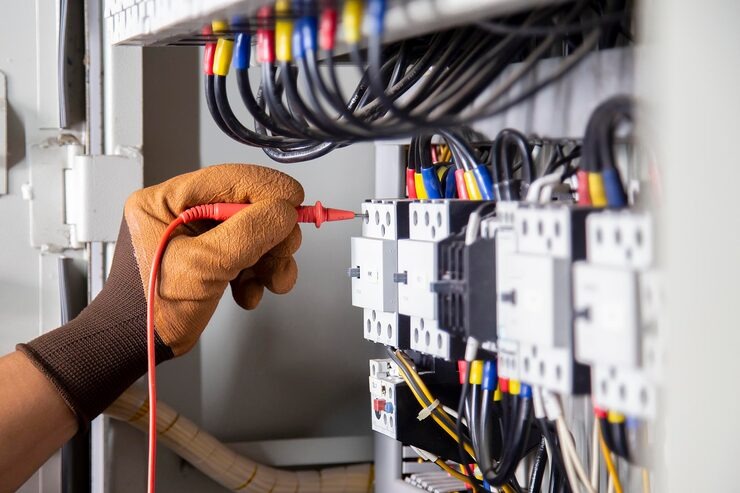
Brandon starts by opening the panel and checking what’s actually available – breaker slots, amperage headroom, and whether the existing circuit serving that room can take the added load or needs its own dedicated circuit. Old cloth wiring or aluminum branch circuits get flagged before anything else happens, because running new fixtures off wiring that’s already failing is not a fix, it’s a delay.
Power to the work area gets shut off at the breaker, not at the main, so the rest of the house keeps running. For most rooms that means the space is dark for a few hours, not all day. From there it’s cutting can locations, fishing cable through the ceiling bay (harder in plaster ceilings and old farmhouse framing than in open-joist new construction), setting IC-rated housings where insulation is present, wiring in a dimmer if you want one, and testing every fixture on the circuit before the ceiling gets patched. The utility company has no role in this kind of work unless the panel itself needs more capacity – that’s a separate conversation, and Brandon will tell you plainly if your project needs it.
What It Costs
Recessed lighting installation in Topsfield generally runs {PRICE_LOW} to {PRICE_HIGH}, and the spread comes down to a few things: how many cans, whether the ceiling is open from above (attic access) or closed and needs to be fished blind, whether you’re adding dimmers or smart switches, and whether the existing circuit has room or a new one has to be run back to the panel. Plaster ceilings and finished basements with no attic access above them take longer than a straightforward drywall ceiling, and that shows up in the estimate. Brandon gives you a number after he’s seen the ceiling and the panel, not before.
How long it takes
A single room – a kitchen or a living room with six to ten cans – is usually a one-day job. Whole-house projects, or ones that turn up wiring problems once the ceiling is opened, run longer. If your panel needs upgrading to support the added circuits, that’s typically scheduled as its own visit rather than squeezed into the same day, since it may require coordinating a shutoff with the utility.
Permits and inspection
Electrical work in Massachusetts, recessed lighting included, requires a permit and a local inspection. That’s not paperwork for its own sake – it’s the difference between work that’s checked against the Massachusetts Electrical Code and work that isn’t. Brandon pulls the permit, schedules the inspection, and stands behind what’s behind your ceiling. If you’re comparing quotes and one of them doesn’t mention a permit, that’s worth asking about directly. [EXTERNAL LINK: Massachusetts Board of State Examiners of Electricians – electrical permit and licensing requirements]
Common Questions
Can recessed lighting be added to a plaster ceiling?
Yes, but it takes more care than a drywall ceiling. Plaster is more likely to crack when cutting can holes, and there's often no attic access above older sections of a farmhouse, so cable has to be fished carefully rather than dropped in from above. It adds some time but it's routine work for us.
Will adding recessed lights overload my panel?
It depends on what's already on the circuit and what your panel has available. Homes in Topsfield with older 60 amp services or a full panel sometimes need a dedicated circuit or a panel upgrade before new lighting is added. Brandon checks this before any work starts.
Do I need a permit for recessed lighting installation?
Yes. Electrical work in Massachusetts requires a permit and inspection regardless of the size of the job. We handle the permit and schedule the inspection as part of the project.
How many recessed lights does a typical kitchen need?
It depends on the room size and ceiling height, but most kitchens use somewhere between six and twelve cans spaced to avoid shadowed corners and give even coverage over counters and the sink. Brandon lays this out on site rather than guessing from a floor plan.
Can I add a dimmer with new recessed lighting?
Yes, and most homeowners do. It's a small add to the labor if it's done at the same time as the installation, and it gives you real control over the room instead of one on-off setting.
Reach Out for Recessed Lighting Installation
If you’re planning a kitchen remodel, finishing a basement, or just tired of one dim overhead fixture, call {PHONE} to get Brandon out to look at the space. We work across Topsfield and the rest of the North Shore, and we’ll tell you straight whether your panel and wiring are ready for it before any cans go in.
Contact information
Talk to Brandon
Brandon is the electrician on the Belfiore team – he left union work to run the electrical side of a family plumbing and electrical business based out of Salem. He looks at the panel and the ceiling in person before quoting anything, because on a lot of Topsfield properties the wiring behind the wall is the real story, not the fixture count.