
Outlet and GFCI Installation and Repair in Marblehead, MA
A lot of Marblehead houses were wired for a family that used a radio, a toaster, and maybe a window fan. Now the same two-prong circuit in the back bedroom is expected to run a laptop, a space heater, and a phone charger at the same time, and the outlet either sparks, falls out of the wall, or just stops working. That gap between what the house was built for and what people actually plug in now is the whole reason this page exists.
Outlet and GFCI Installation and Repair in Marblehead
Outlet work sounds small and it usually is, in terms of the time it takes. But in Marblehead it is rarely as simple as swapping a faceplate. Brandon gets called out for cracked and yellowed outlets in houses near the water, GFCI protection that’s missing entirely in kitchens and baths that predate the current code, and circuits that trip the second you run a hair dryer and a space heater on the same wall. This is steady, unglamorous work, and it’s also usually the first job that brings a homeowner here before a bigger project – a panel upgrade, a remodel, a generator – comes up later.
Why Marblehead homes need this
Marblehead has one of the oldest housing stocks on the North Shore, plenty of it eighteenth and nineteenth century, with additions and updates layered on in whatever decade someone got around to it. That means we still find knob and tube wiring behind walls, cloth-insulated conductors that have gone brittle, and 60 amp services that were adequate in 1955 and are not adequate now. Some of these houses still have a Federal Pacific or Zinsco panel from a mid-century renovation – both are known for breakers that don’t trip reliably when they should, which is a real safety issue, not a scare tactic.
Add in the salt air off the harbor. Any outlet or receptacle mounted outside, in a garage close to the water, or in an unheated mudroom takes a beating from corrosion that inland towns don’t deal with the same way. Tight lots and narrow streets also mean equipment access is harder here than in a lot of our other towns, which is one reason Chris flags Marblehead as a place where jobs run a little longer and carry a higher ticket than average.
On top of the old-house factor, Marblehead has real coastal outage exposure. Nor’easters and harbor-side wind take the power down here more often than in towns set back from the water, and it’s a big reason generator interest runs high in this town – a topic for a different page, but it starts with the same electrician looking at the same panel.
What the work involves
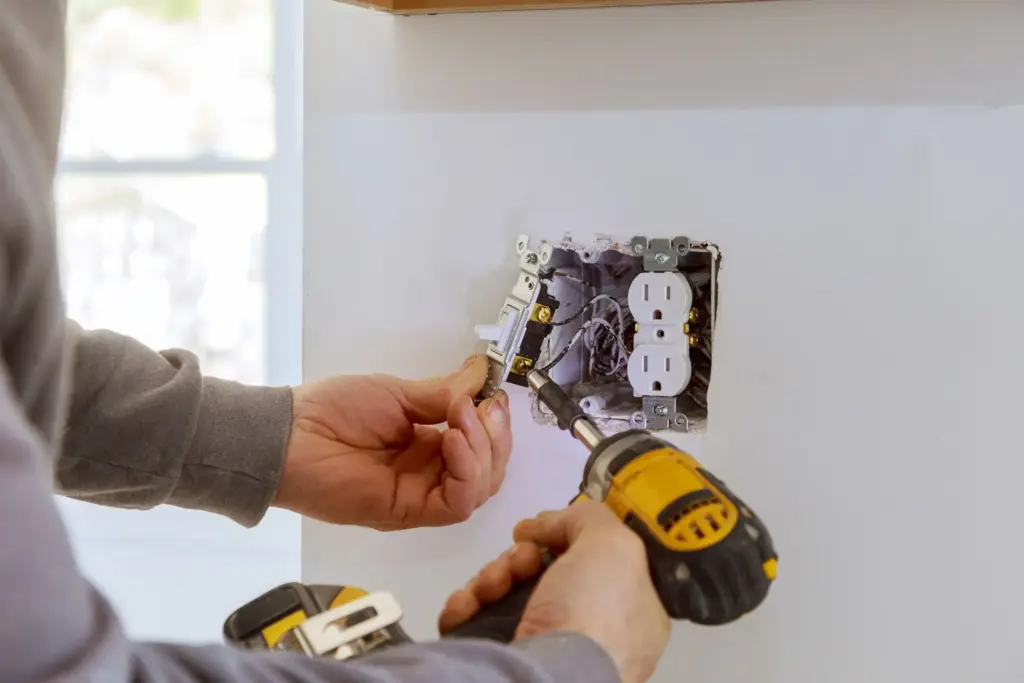
For a standard outlet swap or GFCI installation, Brandon kills power to the circuit at the panel, not just the switch, and tests it dead before touching a wire. Power to that circuit is out for the length of the job, usually well under an hour per device. The rest of the house stays live.
GFCI protection is required by code in kitchens, bathrooms, garages, unfinished basements, and any outdoor receptacle. In an older Marblehead house, that often means adding protection that was never there to begin with, not just replacing a broken outlet. Where the existing wiring is copper and in good shape, it’s a straightforward device swap. Where it’s aluminum, knob and tube, or cloth-insulated and brittle, the job becomes a wiring repair first and an outlet installation second – and Brandon will tell you that up front rather than covering it up with a new faceplate.
None of this touches the utility side. National Grid owns the meter and the service drop; Brandon’s work starts at the panel and runs to the device. If the underlying issue traces back to a 60 amp service that can’t support what’s being asked of it, that’s a separate conversation about a service upgrade, not something folded quietly into an outlet call.

What It Costs
A single outlet or GFCI replacement in Marblehead generally runs {PRICE_LOW} to {PRICE_HIGH}, depending on what’s actually behind the wall. A clean copper circuit with easy access is the low end. A GFCI added where none existed, knob and tube wiring that needs to be cut back and repaired, or a receptacle buried in a finished wall with no access panel all push it higher. Outdoor and near-water locations sometimes need weatherproof, in-use covers to meet code, which adds a small amount of hardware cost. Brandon prices the job after he’s seen the wiring, not off a phone call, because in a house this old the guess and the reality can be pretty far apart.
How long it takes
Most single-outlet or GFCI jobs are done in one visit, often 30 to 90 minutes of actual work once the circuit is confirmed and power is shut off. Multiple outlets on one visit – say, bringing an entire kitchen or bathroom up to current GFCI requirements – usually takes half a day. If knob and tube or aluminum wiring turns up mid-job, that can add time, since it’s a repair on top of the original ask. Brandon will tell you before he starts cutting into anything unexpected, not after.
Permits and inspection
Straightforward outlet swaps on existing wiring typically don’t require a permit. New circuits, added GFCI protection where none existed, or any work that touches the panel does require a permit through the Marblehead building department, and it gets inspected before it’s closed up. This is not paperwork for its own sake – it’s the difference between a licensed electrician’s work and a handyman’s work, and it’s the reason a homeowner selling an older house benefits from having that inspection on record. [EXTERNAL LINK: Massachusetts Board of State Examiners of Electricians – state electrical code reference, to explain what governs this work]
Common Questions
Do I need GFCI outlets in my Marblehead house if it passed inspection years ago?
Code requirements have expanded significantly since older homes were last inspected. Kitchens, bathrooms, garages, and outdoor receptacles are all required to have GFCI protection now, regardless of when the house was built. A lot of older Marblehead houses are missing it in one or more of these spots.
What is knob and tube wiring and does my house have it?
It's an early wiring method using ceramic knobs and tubes to run individual insulated conductors through framing, common in houses built before the 1940s. Marblehead has plenty of houses old enough to still have some. It's not automatically dangerous, but it has no ground and doesn't handle modern loads well, so it often needs attention when you're adding outlets or GFCI protection.
Why does my outlet keep tripping when I only plug in one thing?
That usually points to either a failing GFCI device, a loose connection generating heat, or a circuit that's undersized for what's being asked of it. It's worth having it looked at rather than just resetting it repeatedly – a breaker or GFCI that keeps tripping is doing its job, and ignoring it isn't a fix.
Can I install a GFCI outlet myself?
You can buy the device at any hardware store, but in Massachusetts, electrical work legally requires a licensed electrician, and for good reason – miswired GFCI protection can fail silently, meaning it looks fine but doesn't actually protect you. Given the age of wiring in a lot of Marblehead houses, it's not a place to guess.
Why do outlets near the water corrode faster in Marblehead?
Reach Out for Outlet and GFCI Installation and Repair
We work across Marblehead and the rest of the North Shore. Call {PHONE} to describe what you’re seeing – a dead outlet, a missing GFCI, a breaker that won’t stay reset – and Brandon can tell you what to expect before he’s even at the house.
Contact information
Talk to Brandon
Brandon is the licensed electrician at Belfiore. He left union work to run the electrical side of a family business, and outlet and GFCI calls are some of the most common work he does across Marblehead, precisely because the housing stock here demands it. If something in your house sparks, feels warm, or trips for no clear reason, that’s worth a call before it becomes a bigger problem.