
Dedicated Circuit Installation in Topsfield, MA
A lot of Topsfield homes were built when a house ran on a stove, a furnace and maybe a window unit. That original panel, or the 60 or 100 amp service it was upgraded to somewhere along the way, was never sized for a generator transfer switch, a well pump on its own breaker, a workshop in the barn, and a car charging in the driveway. When one of those additions gets wired into a shared circuit instead of its own, breakers trip, appliances hum instead of run right, and the wiring itself heats up more than it should.
Why Topsfield Homes Need This
Topsfield is low density with large lots, long driveways and a real share of homes on well and septic rather than town water and sewer. That last part matters more than people think: a well pump is a motor load, and motor loads need their own circuit sized for the starting current, not a shared line that also feeds the sump pump and the freezer in the basement.
Outages here also run longer. When a tree comes down on a rural line at the end of the feed, National Grid has more line to walk and fewer customers per mile to justify rushing the repair. That is why generator demand in Topsfield is the highest of any town we work in on the North Shore – a transfer switch and a dedicated generator circuit are not a luxury item here, they are how a well-and-septic household keeps running water and heat during a multi-day outage.
Then there is the housing stock itself. We still find knob-and-tube wiring in the older farmhouses, cloth-insulated conductors from the mid-1900s, and panels that were state of the art decades ago and are a liability now – Federal Pacific Stab-Lok and Zinsco panels both show up on the North Shore, and both have a documented history of breakers that fail to trip when they should. Adding a new dedicated circuit to one of those old panels is often the moment that forces the bigger conversation about a panel upgrade.
What the Work Involves
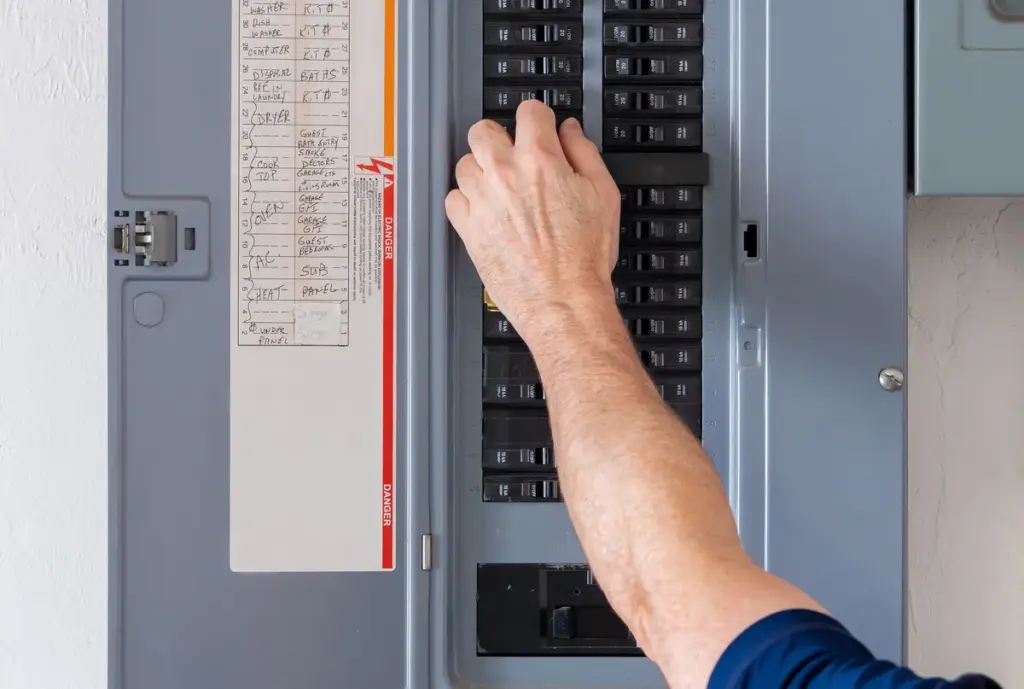
A dedicated circuit is one wire, one breaker, one purpose. No sharing with an outlet down the hall, no sharing with the lights. Brandon runs the job from the panel out: confirming there’s an open slot or making room, sizing the wire gauge to the amperage the appliance actually draws (10 gauge for a 30 amp range circuit, 6 gauge for a 50 amp EV charger, 8 gauge for many well pump setups), and matching the breaker type to the load – a GFCI breaker near water, an AFCI breaker where code requires arc-fault protection, a double-pole breaker for 240 volt equipment like a dryer, range, heat pump or car charger.
For most single-circuit jobs, the power in the affected part of the house is off for a few hours, not the whole day. On older farmhouses where the run has to go through fieldstone foundations, plaster walls or a finished attic, we talk through the path before opening anything up, because a straight run behind drywall is a different job than fishing wire through balloon-frame walls built in 1890.
If the service itself is undersized – a 60 amp farmhouse service trying to feed a generator circuit, an EV charger and a modern kitchen – that’s a utility and panel conversation, not a wiring conversation. National Grid handles the service drop and meter; Brandon handles everything from the meter socket inward, including any panel or service upgrade that has to happen first.
What It Costs
A straightforward dedicated circuit for a window AC unit or a kitchen appliance, run a short distance from an existing panel, typically runs {PRICE_LOW} to {PRICE_HIGH}. That range moves with wire length, whether we’re fishing through finished walls or an old fieldstone foundation, whether the panel has an open breaker slot or needs a subpanel added, and the amperage of the load itself – a 50 amp EV charger circuit costs more in materials and labor than a 15 amp circuit for a sump pump. Generator transfer switch circuits and well pump circuits also run toward the higher end because of the wire gauge and the disconnect equipment involved. Brandon gives you the number for your specific job before any wire gets pulled, not after.
How Long It Takes
One dedicated circuit, straightforward path, is usually a same-day job – a few hours of work and inspection can follow within days depending on the local building department’s schedule. Multiple circuits, or a job that turns up knob-and-tube or a Federal Pacific panel along the way, runs longer because we’re not going to land a new dedicated circuit on old, brittle wiring or a panel with a known failure history without addressing that first. On estate properties with long conduit runs to a barn or detached garage, trenching and conduit add their own timeline separate from the electrical work itself.
Permits and Inspection
Dedicated circuit work is permitted in Massachusetts, full stop. Brandon pulls the permit, the work gets inspected by the local electrical inspector, and you get a record that the circuit was installed to code – not just wired to work today. That inspection step is exactly what separates a licensed electrician from someone running a side business off a truck: an inspector is checking wire gauge against breaker size, grounding, box fill and clearance, the same things that matter if you ever sell the house or file an insurance claim. [EXTERNAL LINK: Massachusetts Board of State Examiners of Electricians – licensing and code jurisdiction, useful for homeowners verifying a contractor]
Common Questions
Do I need a permit for a single dedicated circuit in Topsfield?
Yes. Massachusetts requires a permit and inspection for electrical work including new dedicated circuits, regardless of size. Brandon pulls the permit as part of the job.
Can a dedicated circuit be added to a Federal Pacific or Zinsco panel?
Sometimes, but we'll flag the risk. Both panel brands have a documented history of breakers not tripping under fault conditions. Adding load to one is often the point where a panel replacement makes more sense than adding to a panel we don't trust.
My house is on well and septic - does that change the circuit I need?
Yes. Well pumps are motor loads with a starting current higher than their running current, so they need a circuit and breaker sized for that surge, separate from other household loads.
How long will my power be off during the work?
Does a generator need its own dedicated circuit?
Reach Out for Dedicated Circuit Installation
If you’re adding a generator, an EV charger, a well pump, or new kitchen equipment and the existing wiring wasn’t built for it, call {PHONE}. We work across Topsfield and the rest of the North Shore, and we’ll tell you plainly what your panel can handle and what it can’t before we start any work.
Contact information
Talk to Brandon
Brandon is the licensed electrician here, and he’s the one who walks your panel, sizes the circuit and pulls the permit. He left the union to run the electrical side of a family business with his brother Chris, who handles plumbing and heating – so if a generator circuit conversation turns into a question about a boiler or a gas line for a future generator, that’s a conversation you can have in the same phone call.