Electrical Troubleshooting and Repair in Middleton, MA
A lot of Middleton houses were built with a 100 amp panel and a handful of circuits meant for a furnace, a fridge, and maybe a window AC. Now that same panel is being asked to run a heat pump, an EV charger, a finished basement, and a kitchen full of appliances that draw far more than the house was ever wired for. When something trips, dims, or just feels wrong, that gap between old capacity and new demand is usually where the problem starts.
Why Middleton Homes Need This
Middleton’s housing stock spans a wide range of ages, and that matters more than most homeowners realize. On the older end of town you’ll still find knob-and-tube segments in attics and walls that were never fully removed, along with cloth-insulated wiring that’s now brittle enough to crack when it’s disturbed. On the postwar and mid-century side, 60 amp and early 100 amp services are common, sometimes paired with Federal Pacific or Zinsco panels – both known for breakers that don’t trip reliably when they should.
Middleton’s larger lots also mean more homes with detached garages, workshops, and pole barns that were wired decades ago for light duty and are now being asked to run power tools, EV chargers, or a second refrigerator. That’s a different load calculation than a typical in-house circuit, and it’s a common source of the flickering lights and warm outlets we get called out for.
None of this means every old wire in your walls is dangerous. It means troubleshooting has to start with an honest look at what’s actually in the walls, not a guess based on the age of the house alone.
What the Work Involves
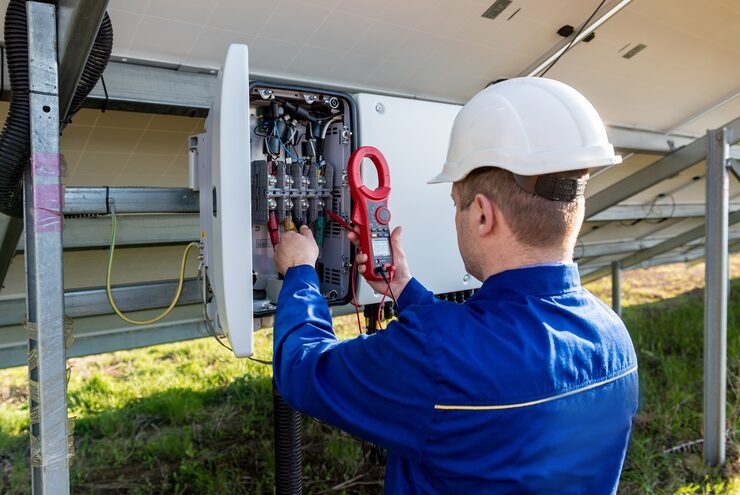
Most troubleshooting calls start with a conversation at the panel. Brandon will check the main breaker size, look at the condition of the bus bar and neutral connections, and test the circuits that are giving you trouble – a breaker that trips under load, an outlet that’s dead, a light that flickers when the dryer kicks on. Some of this is diagnostic work with a multimeter and a thermal read on connections that might be loose or corroded. Some of it means opening a wall or a junction box to trace a run that was never labeled.
Power to the affected circuit gets shut off before any work starts, not the whole house, unless the repair is at the panel itself. A panel-level repair or a full outage while we isolate a fault might mean the house is without power for an hour or two. A single circuit repair is usually much shorter. If the problem traces back to the utility’s drop or meter, that part of the job belongs to National Grid, not to us – Brandon will tell you plainly if that’s what he finds.
Once the fault is found, the fix might be as simple as replacing a failed breaker or as involved as rewiring a run with modern copper and correct gauge for the load. Every repair gets tested under load before we call the job done.
What It Costs
A straightforward troubleshooting call, where the issue is a bad breaker, a loose connection, or a single dead circuit, typically runs in the {PRICE_LOW} to {PRICE_HIGH} range. That range moves depending on how much tracing is involved, whether the panel itself needs work, and whether we’re dealing with old wiring that needs to be replaced rather than repaired. A house with knob-and-tube in the mix or a Federal Pacific panel that needs more than a breaker swap will land higher than a newer home with a clean, well-labeled panel. We’ll give you a number before any work starts, not after.
How Long It Takes
Most troubleshooting and repair visits are done in a single appointment, often two to four hours depending on how much tracing the problem takes. If the fix requires a part we don’t carry on the truck, or if it turns into a bigger job like a panel swap, we’ll say so on the spot and schedule the follow-up rather than stretch out the first visit.
Permits and Inspection
Electrical work in Massachusetts is regulated for a reason, and repairs that go beyond a simple like-for-like part swap require a permit and a town inspection. That’s true in Middleton the same as anywhere else on the North Shore. Brandon pulls the permit, schedules the inspection, and stands behind the work when the inspector shows up. That’s the difference between hiring a licensed electrician and hiring someone off a classifieds listing – the work gets checked by a third party, and there’s a paper trail if anything about the property ever comes into question, including when you go to sell it.
Common Questions
Is it normal for a breaker to trip once in a while?
An occasional trip from an overloaded circuit, like too many space heaters on one line, isn't unusual. A breaker that trips repeatedly, trips with no obvious load, or won't reset at all is a sign of a fault that needs to be traced, not just reset and ignored.
How do I know if my house has a Federal Pacific or Zinsco panel?
These panels were common in homes built or renovated from the 1950s through the 1970s. The brand name is usually printed on the panel cover or the breakers themselves. If you're not sure, Brandon can identify it in a few minutes during a troubleshooting visit.
Can knob-and-tube wiring be repaired instead of replaced?
Sometimes a section can be repaired or isolated, but most insurers and inspectors want it removed from active use rather than patched. We'll tell you honestly what's realistic for your specific wiring rather than pushing a full rewire you don't need.
Will my power be off for the whole house during a repair?
Usually not. Most repairs isolate the single affected circuit. A full shutoff is only needed for panel-level work or when we need to safely trace a fault that runs through multiple circuits.
Do I need a permit just to fix a broken outlet?
A simple like-for-like replacement of a device usually doesn't require a permit. Rewiring, new circuits, or panel work does. Brandon will tell you which category your repair falls into before starting.
Reach Out for Electrical Repair
We work across Middleton and the rest of the North Shore, and we’re a Salem-based company that keeps both plumbing and electrical licensed in-house. If you’ve got a breaker that won’t stay reset, an outlet that’s warm to the touch, or a panel you’re not sure is safe anymore, call {PHONE}. We’ll get you a straight answer and a real plan, not a runaround.
Contact information
Talk to Brandon
Brandon left union work to run the electrical side of this family business, and troubleshooting calls are where a lot of the bigger jobs on this page start – panel upgrades, dedicated circuits, EV charger installs. He’d rather look at the actual panel and actual wiring than guess over the phone. If something in your Middleton home is tripping, flickering, or just feels off, call and describe what’s happening. He’ll tell you honestly whether it’s a quick fix or the sign of something bigger.