
Outlet and GFCI Installation and Repair in Rowley, MA
A lot of Rowley houses were built long before anyone plugged in a microwave, a well pump, and a chest freezer at the same time. If your kitchen or bathroom still has two-prong outlets, or if a single circuit trips every time you run the coffee maker and the toaster together, the wiring is telling you it was sized for a different house than the one you’re living in now.
Outlet and GFCI Installation and Repair in Rowley
Belfiore handles outlet and GFCI work across Rowley for homeowners dealing with dead outlets, ungrounded two-prong receptacles, tripping GFCIs, and kitchens or bathrooms that were never updated to current code. This is steady, practical work, and it’s often the first job that brings a homeowner and an electrician together before a bigger project comes along.
Brandon handles the diagnosis and the install himself. On a service call like this you’re not getting a dispatcher reading from a script, you’re getting the licensed electrician who’s going to open the panel and trace the circuit.
Why Rowley homes need this
Rowley has a lot of farmhouse and colonial-era housing on rural lots, plus newer construction mixed in on well and septic systems. The older stock is where the real electrical issues live. Original 60 amp services, cloth-insulated wiring from the 1940s and 50s, and in some cases actual knob-and-tube runs still feeding a bedroom or attic circuit are not rare finds out here. None of that wiring has a ground conductor, which means every outlet on it is a two-prong outlet with no path to protect you from a shock.
Add in that many Rowley properties run a well pump, and you’ve got a load that older 100 amp panels were never sized for once you also add central air, an electric dryer, and maybe a hot tub or a workshop. This is also generator country. Long outages after nor’easters and ice storms push a lot of homeowners here toward interlock kits and transfer switches, and that conversation almost always starts with a look at the panel and the outlets feeding the essentials.
Kitchens and bathrooms are the most common trigger for a call. If your bathroom outlet has no reset button, or your kitchen counter outlets are all on one breaker with the refrigerator, that’s original wiring that predates the GFCI and AFCI requirements in today’s code.
What the work involves
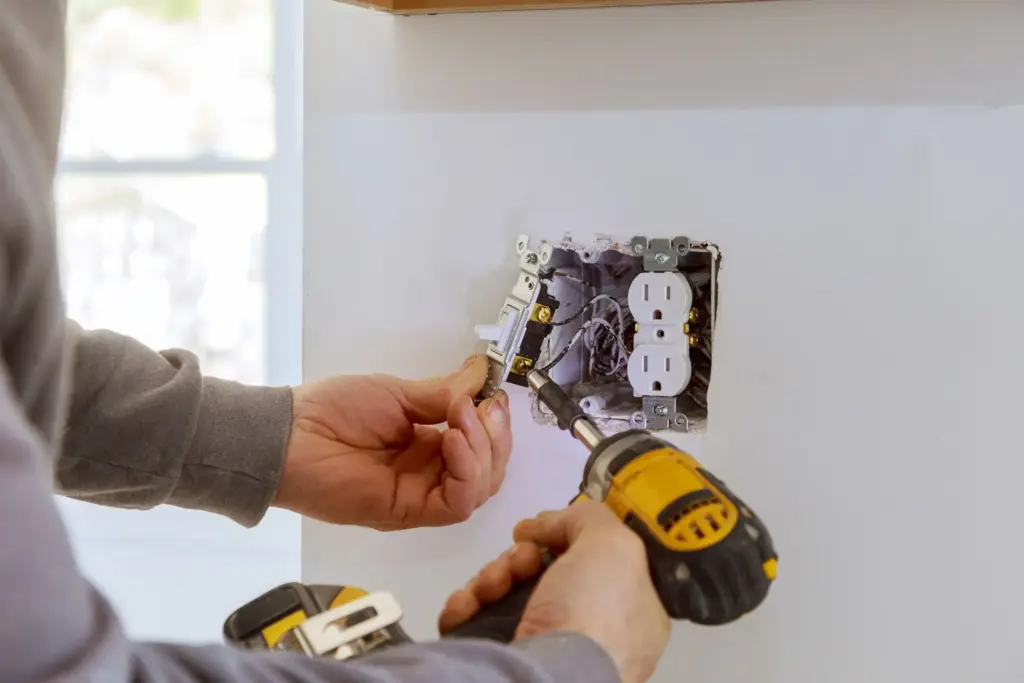
For a straightforward outlet swap or GFCI install, Brandon shuts off the circuit at the panel, confirms it’s dead with a meter, then replaces the device. If the outlet is ungrounded, that gets flagged, since a GFCI can be installed on an ungrounded circuit legally but it has to be labeled ‘No Equipment Ground’ and won’t protect connected equipment the way a true ground does.
Bigger jobs, like adding a new outlet circuit for a kitchen island or a garage, mean running new cable, sizing the wire correctly for the breaker (usually 12-gauge on a 20 amp circuit, 14-gauge on 15 amp), and landing it in the panel on an open slot or a new breaker. The power to that circuit is out for the duration of the work, typically a few hours, not the whole house.
The utility, National Grid in this part of Rowley, only gets involved if the service itself needs upgrading or there’s a meter issue. Everything downstream of the meter, including your outlets, GFCIs, and panel circuits, is the electrician’s work and the electrician’s responsibility.
Bathrooms, kitchens, garages, unfinished basements, and any outlet within six feet of a sink need GFCI protection under current code. Brandon checks the whole circuit while he’s in there, not just the one outlet you called about, because on old wiring one bad connection upstream can cause problems that look like they’re coming from somewhere else entirely.

What It Costs
A single GFCI outlet replacement runs toward the lower end, around {PRICE_LOW}. Adding a new dedicated outlet circuit, running new wire from the panel, or dealing with an ungrounded two-prong situation that needs more than a swap pushes toward {PRICE_HIGH}. What moves the number is wire run length, whether the circuit has to be fished through finished walls or an old plaster ceiling, and whether the panel has room for a new breaker or needs a subpanel or tandem breaker to make space.
Brandon gives you the number before anything gets opened up, not after.
How long it takes
A single outlet or GFCI swap is usually done in under an hour, with the power to that one circuit out the whole time. A new circuit run for a kitchen addition or a garage sub-panel outlet takes longer, often a half day, depending on how far the wire has to travel and whether it’s running through open basement joists or has to be fished through finished walls with old plaster and lath.
Permits and inspection
New circuits and any work that adds wiring to your home need a permit in Massachusetts, and that permit gets signed off by a local inspector once the work is done. This isn’t paperwork for its own sake. It means someone besides the electrician who did the work is looking at it before it gets closed up behind a wall or a cover plate. A straight swap of one GFCI for another failed unit on an existing circuit typically doesn’t require a permit, but new circuits, panel changes, and grounding work do. Brandon pulls the permit and handles the inspection scheduling as part of the job, so you’re not the one on the phone with the town.
[EXTERNAL LINK: Massachusetts Electrical Code (527 CMR 12) amendments to NEC, for homeowners who want to see the GFCI and AFCI requirements directly]
Common Questions
Can I just replace an outlet myself?
You can legally replace a like-for-like outlet in Massachusetts without a permit in most cases, but if the outlet is ungrounded, part of an old cloth-wired circuit, or near water, it's worth having a licensed electrician look at the circuit first. What looks like a simple swap sometimes uncovers wiring that shouldn't be touched without shutting down the circuit properly.
Why does my GFCI keep tripping?
A GFCI trips when it detects current leaking somewhere it shouldn't, even a small amount. Common causes are a worn appliance cord, moisture in an outdoor or bathroom box, or a wiring fault further down the circuit. If it trips repeatedly with nothing plugged in, that's worth a diagnostic visit rather than just resetting it and moving on.
Do all my outlets need to be GFCI protected?
No. Current code requires GFCI protection in kitchens, bathrooms, garages, unfinished basements, outdoor locations, and anywhere within six feet of a sink. Bedrooms and living rooms typically don't require it, though they may need AFCI protection instead depending on when the circuit was installed.
What's the difference between GFCI and AFCI?
GFCI protects against ground faults, the kind of leak that can shock you, and is required near water. AFCI protects against arc faults, the kind that can start an electrical fire inside a wall, and is required on most bedroom and living space circuits in current code. Some panels use combination breakers that do both.
My house still has two-prong outlets. Is that a problem?
Reach Out for Outlet and GFCI Installation and Repair
Belfiore is a Salem-based company working across Rowley and the rest of the North Shore. Two brothers, two licensed trades, one small company that answers the phone itself. Reach out at {PHONE} to get a straight answer on your outlets and get it done right the first time.
Contact information
Talk to Brandon
If you’ve got a two-prong outlet that needs to become three, a bathroom GFCI that won’t reset, or you just want someone to look at a panel that still says Federal Pacific on the cover, call {PHONE}. Brandon will tell you straight what’s original, what’s been added over the years, and what actually needs attention now versus what can wait.