
Outlet and GFCI Installation and Repair in Ipswich, MA
Walk into a lot of Ipswich houses and you’re standing in a home built before the National Electrical Code existed at all. Some of the oldest First Period houses in the country are on these streets, and the wiring inside them has usually been patched, extended, and added to by two or three generations of homeowners before you ever plugged in a laptop or a space heater in the same room.
Outlet and GFCI Installation and Repair in Ipswich
Two-prong outlets with no ground. Warm cover plates. A GFCI in the bathroom that trips every time you run a hair dryer, or worse, one that isn’t there at all. These are the calls Belfiore gets from Ipswich week in and week out. It’s not glamorous work, but it’s the work that actually keeps a house safe, and it’s a good way to get to know an electrician before you need one for something bigger.
Why Ipswich homes need this
A lot of Ipswich housing stock predates grounded wiring entirely. We still find cloth-insulated knob and tube in attics and wall cavities on the older lots near the center of town, and it’s common enough that it isn’t a surprise anymore, just something to plan around. Homes from the 1950s through 70s often carry 60 amp services that were fine for a refrigerator and a radio, not for a kitchen with a microwave, an air fryer, and a coffee maker all pulling from the same circuit.
We also see our share of Federal Pacific Stab-Lok and Zinsco panels out here, both known for breakers that don’t trip when they should. If your panel is one of these, an outlet call is often the moment we flag it, because no GFCI or outlet upgrade fixes a panel that won’t protect the circuit behind it.
Add in well and septic systems, which put pumps and control panels on circuits that were never designed to run them, and long outages during nor’easters and ice storms that push people toward generators and interlock kits. All of that touches the same outlets and panels we’re already looking at.
What the work involves
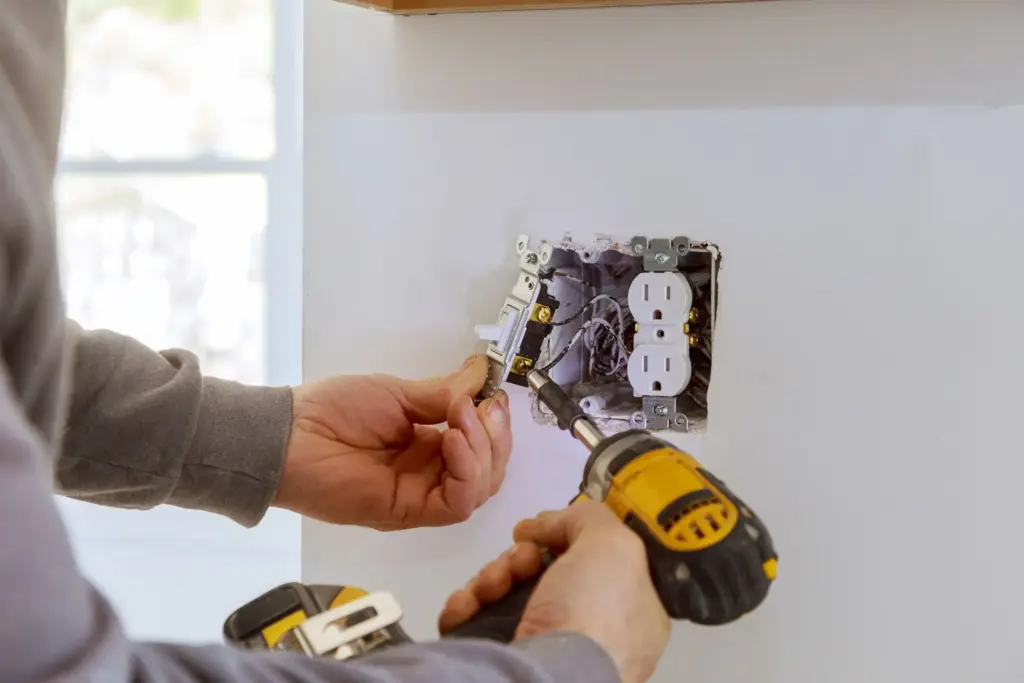
For a straightforward GFCI swap, we kill power to that circuit at the panel, confirm it’s dead with a meter, and the outage is limited to the outlets downstream of that device, usually five minutes or less. Replacing a GFCI without proper downstream wiring, or in a box that’s too small for a modern device, takes longer and sometimes means opening the wall a few inches.
Adding a new outlet is a bigger job. We’re running new cable, usually 12 or 14 gauge depending on the circuit’s amperage, from the panel or an existing junction point to the new location. If we’re fishing wire through a plaster wall in one of the older homes, expect a small patch afterward. For kitchens, bathrooms, garages, and anywhere within six feet of a sink, code calls for GFCI protection, and we test every device we touch with a trip tester before we leave, not just plug it in and walk away.
The utility’s part in most of this is nothing. National Grid only gets involved if we’re upsizing your service entrance, which is a separate job from outlet work. For a standard outlet or GFCI call, it’s Brandon in the panel and Brandon at the outlet, start to finish.
What It Costs
A single GFCI replacement in an accessible location typically runs {PRICE_LOW} to {PRICE_HIGH}. Adding a new outlet on an existing circuit costs more once we’re cutting into plaster, lath, or a finished wall to fish wire, and multi-outlet jobs or new dedicated circuits price out higher again. The real cost driver in Ipswich specifically is wall type. Balloon-frame construction and horsehair plaster in the older homes take longer to open and patch than a modern drywall wall, and that shows up in the number.
How long it takes
One GFCI swap is usually a 20 to 40 minute visit. A single new outlet on an accessible wall, maybe an hour to ninety minutes. If we’re fishing wire through old plaster and lath, or tracing a knob and tube circuit to figure out what it’s actually connected to, plan for longer, sometimes a return visit if we need to open a wall and let a patch dry before we finish.
Permits and inspection
Outlet and GFCI work in Massachusetts requires a permit pulled by a licensed electrician, and the town inspector signs off on it before the job is closed out. That’s not paperwork for its own sake. It means someone other than the person doing the work confirms the grounding, the breaker size, and the device rating all match. A lot of the unpermitted work we find in Ipswich’s older homes is exactly the kind of shortcut that shows up as a warm outlet or a GFCI that doesn’t trip when it should. [EXTERNAL LINK: Massachusetts Electrical Code (527 CMR 12) reference for residential wiring requirements].
Common Questions
Do I need a GFCI outlet in every room?
No. Massachusetts code requires GFCI protection in specific locations: kitchens, bathrooms, garages, unfinished basements, outdoor outlets, and anywhere within six feet of a sink. Bedrooms and living rooms don't require it unless they're near a wet location.
My outlet has two prongs, not three. Is that a problem?
It means the circuit has no ground wire, which is common in Ipswich homes built before the 1960s. It's not an emergency on its own, but it limits what you can safely plug in, and it's worth having checked, especially if you're planning to add outlets or run new appliances.
Can you just replace an outlet without opening the wall?
Most of the time, yes, if the existing wiring is sound and the box is accessible. If the wiring is knob and tube or the box is too small for a modern device, we'll tell you before we start rather than after.
What's the difference between a GFCI outlet and a GFCI breaker?
A GFCI outlet protects that outlet and anything wired downstream of it. A GFCI breaker protects the entire circuit from the panel. Which one makes sense depends on your panel type and how the circuit is laid out, and Brandon can tell you which fits your situation during the visit.
Do you handle the permit and inspection, or do I need to?
Reach Out for Outlet and GFCI Installation and Repair
Call {PHONE} and describe what you’re seeing, whether that’s a tripping breaker, a dead outlet, or a bathroom that’s never had GFCI protection installed. Brandon can usually tell you over the phone whether it’s a quick fix or something that needs a closer look at the panel first.
Contact information
Talk to Brandon
Brandon left union electrical work to run the electrical side of his family’s business alongside his twin brother Chris, who handles plumbing and heating. If you’ve got a two-prong outlet, a panel you don’t trust, or a bathroom that’s never had proper GFCI protection, that’s exactly the kind of call worth making before it becomes a bigger problem.