
Home Rewiring in Marblehead, MA
Home Rewiring in Marblehead, MA
A lot of Marblehead was built before a house needed to run much more than a few lamps and an icebox. Original services were sized at 30 or 60 amps, wired with cloth-insulated copper or, in the oldest sections near the Old Town and Peach’s Point, actual knob and tube. Now those same houses are asked to run central air, an induction range, a home office setup, and an EV charger off wiring that was never meant to carry a fraction of that load.

Home Rewiring in Marblehead
Home rewiring means replacing the electrical conductors in a house, room by room or in full, so the wiring matches how the house is actually used today. It’s not the same job as a panel upgrade, though the two are often done together. A rewire touches the wiring inside the walls and ceilings, the outlets and switches, and often the fixtures themselves, not just the box on the wall where power comes in.
Brandon takes this on as a licensed electrician, not a side job for a handyman with a drill. In a town with as much pre-1900 construction as Marblehead, that distinction matters more than most places.
Why Marblehead Homes Need This
Marblehead has one of the highest concentrations of eighteenth and nineteenth century homes on the North Shore, and that housing stock brings a specific set of electrical problems. Cloth-insulated wiring and knob and tube systems are still live in a meaningful number of attics and wall cavities in town, and both were designed for a load that has nothing to do with modern life. Panels from the 1960s and 70s show up often too, including Federal Pacific and Zinsco brands that are widely known in the trade for breakers that don’t trip reliably when they should.
Add the coastal factor. Salt air is hard on anything mounted outside, from meter housings to outdoor disconnects to generator transfer equipment, and it shortens the working life of exterior electrical components faster than an inland town would see. Tight lots and narrow lanes near the harbor and downtown also mean equipment access for a rewire job takes more planning than it would on a suburban half-acre. And because coastal storms knock out power here more often than in towns set back from the water, a rewire is frequently the moment homeowners also decide to add generator-ready circuits, since the walls are already open.
What the Work Involves
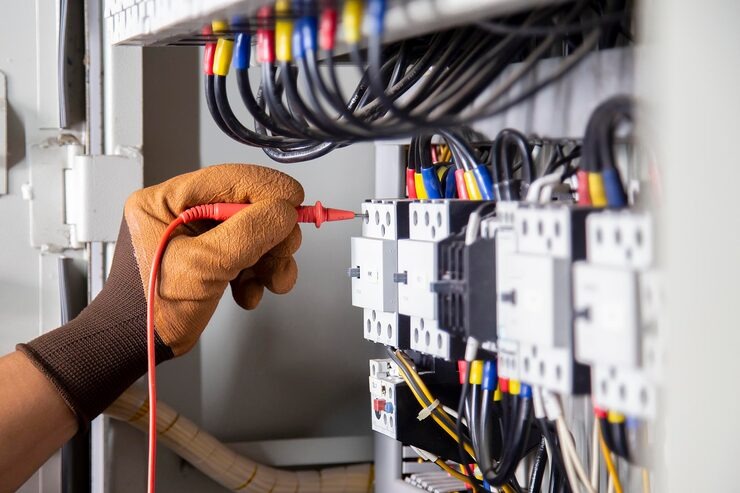
Brandon starts with a full walkthrough: attic, basement, panel, and a sense of how the wiring runs between them. From there, the job generally breaks into a few real steps. Power gets shut off to the areas being worked on, not necessarily the whole house at once. Old wiring gets pulled out or, where it’s not accessible, safely abandoned and capped per code. New copper wire, sized correctly for the circuit (14 gauge for standard 15 amp lighting circuits, 12 gauge for 20 amp outlet circuits, larger gauge for ranges, dryers, and EV chargers) gets run to new or existing boxes.
Some of this is invisible work behind existing plaster or drywall, run through drilled holes and fished with a wire snake. Some of it requires opening a section of wall or ceiling, especially in balloon-frame construction common in Marblehead’s older homes, where there’s no easy horizontal path for a wire to travel. The utility, National Grid in most of Marblehead, is responsible for the service drop and meter, while everything from the meter socket inward is the electrician’s work and the electrician’s inspection responsibility.
What It Costs
A full rewire in Marblehead typically runs {PRICE_LOW} to {PRICE_HIGH}, and the range is wide because the variables are real. A single-story house with an accessible basement and attic costs less to rewire than a three-story antique with plaster walls, horsehair lath, and no straight path for a wire anywhere. Balloon framing, finished ceilings you don’t want cut into, and knob and tube buried under blown-in insulation all add labor time. Whether the panel also needs replacing, and whether you’re adding circuits for a range, EV charger, or generator at the same time, moves the number too. Brandon gives a firm number after he’s seen the house, not a phone estimate.
How Long It Takes
A single room or a small addition can be rewired in a day. A full house rewire is usually measured in days, not hours, and often gets phased so you’re not without power to the whole house at once. Expect one day with a more significant outage when the panel connection happens and the utility handles the meter swap. Older homes with harder access, like Marblehead’s antique housing stock, tend to run longer than newer construction simply because getting the wire from point A to point B takes more care.
Common Questions
Do I need to rewire my whole house, or can it be done in phases?
It depends on the panel and how the existing wiring is distributed. Some Marblehead homes can be split into phases, tackling the kitchen and one floor now and the rest later. Homes still running on a single 60 amp service usually need the panel addressed first, since everything downstream depends on it. Brandon will walk the house with you and lay out what can wait and what can't.
Is knob and tube wiring actually dangerous, or is that overblown?
The wire itself, when undisturbed and not buried in insulation, isn't necessarily a fire waiting to happen. The problems come from age, brittle insulation, past splices done without a junction box, and homeowners adding blown-in insulation over it, which traps heat. Many insurers in Massachusetts also won't write or renew a policy on a home with active knob and tube, which is often what actually forces the decision.
Will I lose power to the whole house during the rewire?
You'll lose power to sections as Brandon works through them, and there's typically one full-day outage when the new panel gets connected and the utility swaps the meter. Outside of that, most of the disruption is room by room, and he'll tell you in advance which days affect which parts of the house.
Can I stay in the house during the work?
Most people do, especially when the job is phased. The exceptions are homes where walls and ceilings are being opened extensively for access, which can make certain rooms unusable for a few days at a time. Brandon will flag this during the walkthrough if it applies to your project.
Does rewiring help with the frequent power outages out here?
Rewiring and generator readiness are two different jobs, but they're often done together. If you're already opening walls and upgrading the panel, that's the right time to add a transfer switch and generator-ready circuits, rather than paying to open the same walls again later.
Permits and Inspection
Rewiring is permitted work in Massachusetts, full stop. Brandon pulls the permit, the town’s electrical inspector reviews the work at the appropriate stages, and the job gets signed off before walls get closed back up. This is one of the clearest ways to tell a licensed electrician’s work from a handyman’s: unlicensed rewiring doesn’t get inspected, doesn’t show up on record if you sell the house, and can create real problems with insurance if there’s ever a fire. [EXTERNAL LINK: Massachusetts Board of State Examiners of Electricians licensing and code page, to show homeowners how to verify a license and what the state code actually requires]
Contact information
Reach Out for Home Rewiring
Belfiore is a Salem-based company, and we work across Marblehead regularly, including the harbor-side streets and older neighborhoods where access and antique construction make the job harder than average. Call {PHONE} to get Brandon out to look at your wiring and get a straight answer on what it’ll take.
Talk to Brandon
If your Marblehead house still has cloth wiring in the attic, a fuse box, or a panel branded Federal Pacific or Zinsco, that’s worth a conversation before it’s an emergency. Brandon will look at what you’ve actually got, tell you straight whether it’s a full rewire or something narrower, and explain the reasoning in plain terms, not jargon.