
Dedicated Circuit Installation in Newburyport, MA
Most of downtown Newburyport was built before anyone plugged in more than a radio and a lamp. A lot of that housing stock still runs on wiring and panel sizes that made sense in 1950, not on a kitchen with an induction range, a heat pump water heater, and a car charging in the driveway. If you’re adding any single piece of equipment that draws real power, it needs its own circuit, sized and protected for that load alone, not tapped off whatever outlet happened to be closest.
Why Newburyport Homes Need This
Newburyport’s housing is old enough that you still run into the full range of legacy electrical problems in one town: knob-and-tube wiring in untouched attics and walls, cloth-insulated conductors from mid-century renovations, and a fair number of 60 amp services that were adequate when the house had a furnace, a fridge, and not much else. Add Federal Pacific or Zinsco panels into the mix, both known for breakers that don’t trip reliably under fault conditions, and you have a downtown core where a new dedicated circuit isn’t a convenience upgrade. It’s often the first thing that surfaces a panel or service problem that’s been sitting there for decades.
The federal and colonial-era homes near the waterfront add another layer: plaster walls, balloon framing, and limited attic or basement access make fishing new wire a slower job than it would be in a 1980s ranch in Salisbury. None of that is unworkable. It just means the circuit run itself, not the outlet or the appliance, is usually where the real labor goes.
What The Work Involves
A dedicated circuit is one wire, one breaker, and one outlet or connection point, built for a single piece of equipment. No shared loads, no other outlets tied in. Brandon starts by confirming what the equipment actually needs: a 240-volt EV charger typically wants a 40 or 50 amp circuit on 8 or 6 gauge copper, a kitchen range might call for 40 or 50 amp depending on the unit, and a window or ductless AC condenser usually runs on a 20 or 30 amp circuit depending on nameplate rating. That number comes off the equipment’s data plate, not a guess.
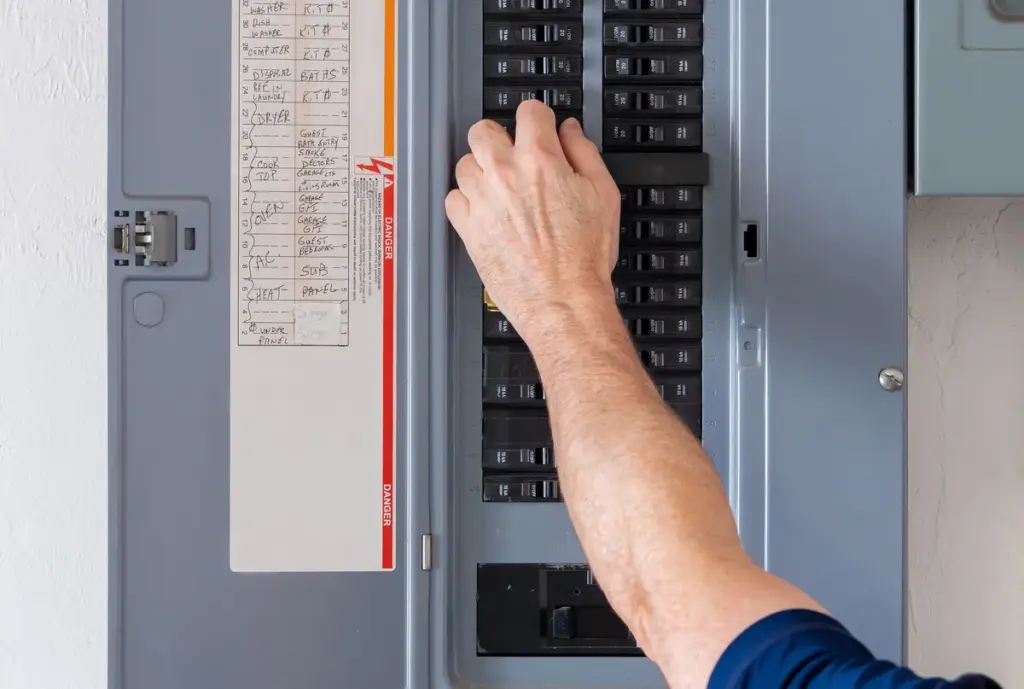
From there it’s a matter of routing: from the panel, through framing or conduit, to the new location. In finished walls that often means opening a small amount of drywall or plaster, running the wire, and patching, or using conduit along a basement ceiling where that’s cleaner. The breaker gets installed at the panel and labeled. Power to the circuit being worked on is off for the duration, but the rest of the house typically stays live unless the panel itself needs isolation for the tie-in, which is usually under an hour.
The utility isn’t involved for a standard dedicated circuit unless the added load pushes your total service past what the existing meter and service entrance can handle. That’s a separate conversation, and it’s one Brandon will flag up front if your 60 or 100 amp service is already close to its ceiling before the new circuit even goes in.
What It Costs
A straightforward dedicated circuit in Newburyport, from an accessible panel with a short, open run, generally lands between {PRICE_LOW} and {PRICE_HIGH}. What moves that number: how far the equipment sits from the panel, whether the wire has to travel through finished plaster or lath and needs patching after, whether the panel has open breaker slots or needs a tandem breaker or subpanel to make room, and whether the circuit is 120 or 240 volt. A 50 amp range circuit with a long run through a finished dining room costs more than a 20 amp circuit for a garage compressor with open joist bays to work through. Brandon prices it after he’s seen the panel and the route, not off a phone description.
How Long It Takes
Most single dedicated circuits are a one-day job, start to finish, including the breaker install and testing. Runs that require opening and patching plaster walls, or that need a panel modification first, can stretch to two days, with the patching and paint touch-up sometimes handled by a separate contractor after the electrical work passes inspection. EV charger installs are usually the fastest of the group when the panel has room, often done in a few hours.
Permits and Inspection
New circuit work in Massachusetts requires a permit pulled by a licensed electrician and a follow-up inspection by the local wiring inspector before the circuit is energized for use. Brandon pulls the permit, does the work to the requirements in the Massachusetts Electrical Code, and schedules the inspection. That inspection is a real check on the work, not paperwork. It’s also the clearest difference between hiring a licensed electrician and hiring someone with a truck and a drill. Unpermitted circuit work is common enough in older housing stock like Newburyport’s, and it’s also one of the first things a home inspector flags when a house goes on the market. [EXTERNAL LINK: Massachusetts Electrical Code (527 CMR 12) reference on Mass.gov, for readers who want the code language behind permitting requirements]
Common Questions
Do I need a dedicated circuit for an EV charger?
Yes, in almost every case. Level 2 EV chargers draw enough continuous current that they need their own 240-volt circuit, sized to the charger's specification, usually 40 or 50 amps on dedicated wire. Sharing that load with any other outlet or appliance isn't allowed under code and isn't safe in practice.
Can my 60 amp service handle a new dedicated circuit?
It depends what else is already on it. A 60 amp service in an older Newburyport home is often already carrying a furnace, water heater, and general household load close to capacity. Brandon checks the existing load before adding anything, and if there isn't room, a service upgrade to 100 or 200 amps usually comes first.
Will you have to open my walls?
Sometimes, especially in plaster-and-lath construction common in Newburyport's older homes. Brandon will tell you before starting whether the run can go through open framing in a basement or attic, or whether it needs a section of wall opened and patched.
Is a permit really required for one new circuit?
How is this different from just running a new outlet?
Reach Out For Dedicated Circuit Installation
If you’re adding an EV charger, a new range, a heat pump, or any equipment that needs its own circuit, call {PHONE}. Belfiore is a Salem-based company and we work across Newburyport and the rest of the North Shore, on the same panels and the same century-old wiring, job after job.
Contact information
Talk To Brandon
Brandon is the licensed electrician on the Belfiore team. He’ll walk your panel, confirm what your equipment actually draws, and tell you straight whether your existing service can absorb a new circuit or whether that conversation needs to happen first. No sales pitch, just what the panel and the code require.