Generator Installation and Connection in Georgetown, MA
Generator Installation and Connection in Georgetown
A lot of Georgetown houses were built when a well pump and a septic pump weren’t even part of the load calculation, because they didn’t exist yet or ran on a system that wasn’t electric. Now those same houses have a submersible pump, a septic pump station, a furnace with an igniter and blower, and maybe a mini split, all sitting on a service that was sized for a lot less. When the power goes out here, it doesn’t just mean dark rooms. It means no water and no way to flush.
Why Georgetown Homes Need This
Georgetown sits back from the coast but the outages don’t care. Wind and ice knock trees into lines out here just as hard as anywhere closer to the water, and because the roads are longer and the lines run through more woods, the repair crews take longer to reach you. A two hour outage in a denser town can turn into a two day outage on some of these rural roads.
On top of that, well and septic are the norm, not the exception, once you get off the main routes. No power means no pump, and no pump means no water in the house at all, whether that’s a shower, a toilet, or water for a fire hose if it ever came to that. A generator here isn’t a comfort item. It’s the thing that keeps the well and the septic pump running until the lines are back up.
The housing stock adds its own wrinkle. Plenty of Georgetown homes are old enough that we still find cloth-insulated wiring in the attic, 60 amp services that were never upgraded, and in some cases knob and tube still live behind a wall that’s never been opened up. Any generator connection on a place like that starts with an honest look at the panel and the service size, not just a hookup.
What the Work Involves
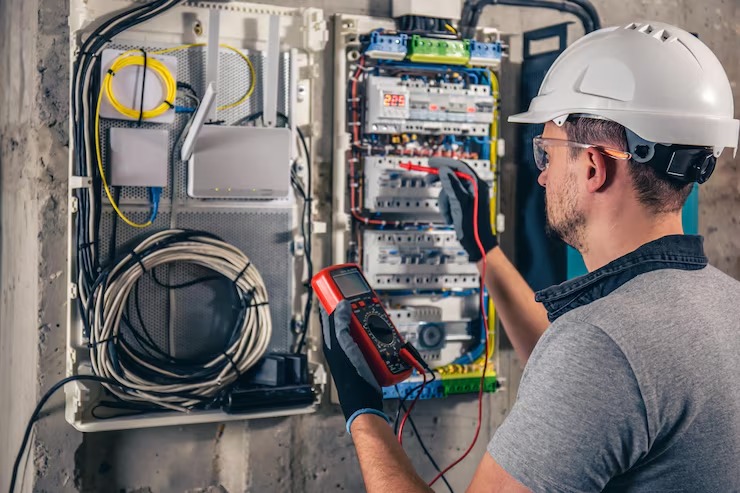
For a standby generator, the job starts with a load calculation. We look at what actually needs to run during an outage: the well pump, the septic pump, the furnace or boiler, a couple of circuits for the kitchen and living space. That tells us the generator size and whether we’re running the whole panel or a managed subset of circuits.
An automatic transfer switch gets installed next to your existing panel. This is the piece that senses a utility outage and switches the house over to generator power automatically, then switches back once utility power is stable. It’s also what keeps the generator from ever backfeeding onto the utility line, which is the actual safety risk with a badly installed setup.
The generator itself sits outside on a pad, usually propane or natural gas fed, with clearances from windows, doors, and the property line that the manufacturer and the town both require. Gas sizing matters here. A 22 kW unit needs a certain size gas line and regulator, and undersizing it is a common mistake that shows up as the generator struggling under load.
Your power gets shut off for the connection work itself, usually for a few hours while we tie into the panel and set the transfer switch. If the service itself needs upgrading first, the utility handles the service drop and meter work on their end, and we handle everything from the meter socket into the house.
What It Costs
A standby generator installation in Georgetown typically runs {PRICE_LOW} to {PRICE_HIGH}. The spread comes down to generator size, whether you’re running the full panel or a load-managed subset, how far the unit sits from the panel, and whether the gas line needs to be upsized or extended. A house on natural gas is usually simpler than one running off a propane tank that also has to be sized or added. If your panel or service also needs work to handle the new load, that’s priced separately and we’ll walk you through why before any of it starts.
How Long It Takes
Most standby generator installations take one to two days of hands-on work: setting the pad and generator, running the electrical whip and gas line, wiring in the transfer switch, and testing the automatic transfer under a real load. If your service needs an upgrade at the same time, add another day. The permit and inspection process on top of that usually adds a week or two depending on the town’s inspection schedule, so from first call to a fully signed-off system, plan on two to four weeks total.
Permits and Inspection
Generator installation is permitted electrical work in Massachusetts, full stop. That means a permit gets pulled before work starts, the transfer switch and wiring get inspected by the town’s electrical inspector, and the gas connection gets its own inspection if it wasn’t already part of an existing line. This isn’t paperwork for its own sake. An improperly installed transfer switch can backfeed the utility line and put a lineman at risk, which is exactly the kind of failure the inspection catches before it becomes a problem. Anyone offering to skip the permit is offering you an uninspected, unlicensed installation on your own electrical service.
Common Questions
Do I need a whole-house generator or can I get by with a smaller one?
It depends on your well pump size, whether you have a septic pump, and what heating system you run. A lot of Georgetown houses do fine with a managed system that covers the well, septic, heat, and a few key circuits rather than the entire panel. Brandon can size it after seeing your panel and running the numbers.
Can I keep my propane tank or do I need a bigger one?
Depends on the generator size and what else runs off that tank. Some households need to upsize the tank or add a dedicated one for the generator, especially if the existing tank also feeds a boiler or range.
Will the generator run my well pump and septic pump at the same time as everything else?
That's exactly what the load calculation is for. We size the generator and, if needed, set up load management so the well and septic pumps get priority and larger draws like an electric range or AC don't overload the unit.
How often does the generator need maintenance?
Standby generators need periodic oil changes and a self-test cycle, similar to a car engine. Most units run a short self-test weekly on their own. We can go over the manufacturer's maintenance schedule when the system is installed.
Is my old 60 amp service a problem for a generator?
It can be. If your existing service is undersized for what you're already running, adding a generator connection is a good time to talk about a service upgrade so the transfer switch has enough capacity to work with.
Reach Out for Generator Installation
If you’re in Georgetown and tired of guessing how long the next outage will last, call {PHONE} and we’ll set up a time to look at your panel and your house. We’re a Salem-based company working across Georgetown and the rest of the North Shore, and this is a job we do properly the first time, permit and inspection included.
Contact information
Talk to Brandon
Brandon is the licensed electrician on the Belfiore team and he’s the one who’ll walk your panel, run the load calculation, and tell you straight whether a whole-house or a managed system makes sense for your house. He’ll also tell you if your existing service is the actual bottleneck before a generator conversation even makes sense.