Outlet and GFCI Installation and Repair in North Reading, MA
Most houses in North Reading went up during the post-war building boom or the subdivision push that followed it in the 60s and 70s, on lots big enough for a two-car driveway and a detached garage. Those houses got a service panel sized for a refrigerator, a window AC unit and maybe an electric dryer. Nobody was thinking about an EV charger in the garage or a heat pump on the back wall, and the outlets themselves were never built with ground fault protection in mind.
Outlet and GFCI Installation and Repair in North Reading
Brandon gets called out to North Reading for two kinds of jobs, and they usually show up together. One is a homeowner who wants outlets that actually work for how the house is used now – a kitchen counter with two-prong outlets from the 60s, a basement someone is finishing into a home office, a garage that needs a 240-volt run for a charger. The other is a GFCI problem: a bathroom or exterior outlet that trips for no clear reason, or a home that has no GFCI protection at all in the rooms that now require it under Massachusetts electrical code. Both jobs are straightforward for a licensed electrician and both matter more than people expect until something goes wrong.
Why North Reading homes need this
The town has a mix of eras, and each one comes with its own wiring problem. Capes and ranches from the 1950s and early 60s often still carry a 60 amp service, sometimes with cloth-insulated wiring or knob-and-tube in sections that were never touched during a renovation. Colonials from the later boom years usually have 100 amp service, which was fine in 1975 and is tight now once you add central air, an electric range and a level 2 EV charger to the load. Some of these homes still have Federal Pacific or Zinsco panels, brands that have a known history of breakers failing to trip when they should – that is not a maintenance item, that is a panel that needs to be evaluated.
Add to that the larger lots and detached garages common around North Reading, which means longer outdoor circuit runs for pools, sheds and workshops, all of which need GFCI protection under code. This is the cleanest market in our service area for EV charger circuits and dedicated circuits, because the housing stock is exactly the size and age where the original panel and the modern electrical load stopped matching up.
What the work involves
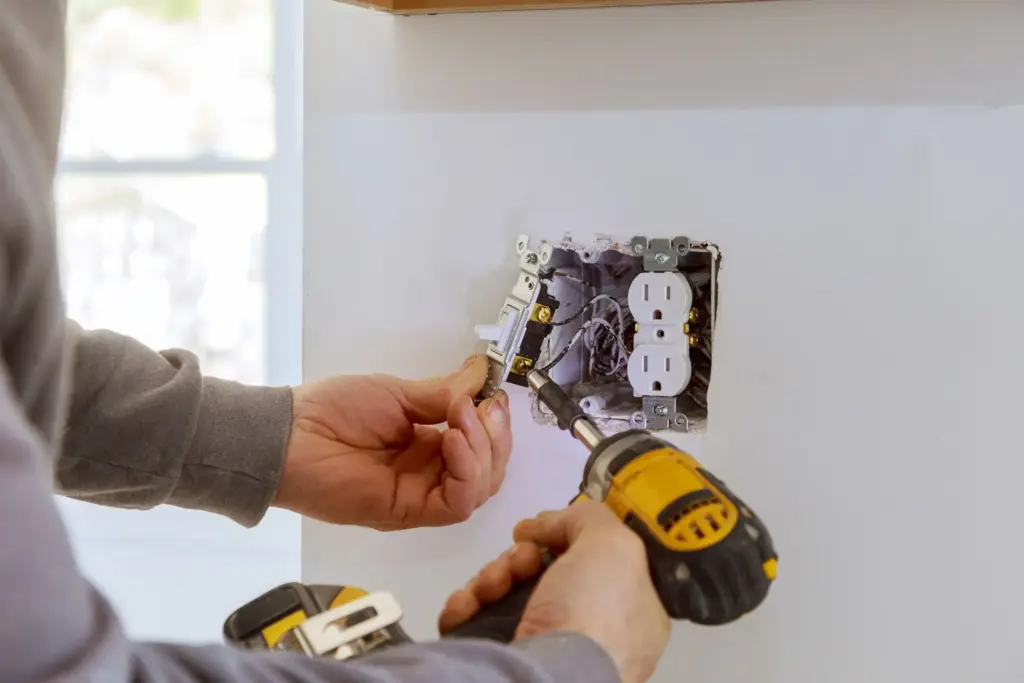
For a straightforward outlet swap or GFCI replacement, Brandon kills power to that circuit at the panel, tests it dead, and does the work with the rest of the house running normally – power is out for that one circuit only, usually 20 to 40 minutes. Adding a new outlet or a dedicated circuit means running new wire from the panel, sized correctly for the load – 12 gauge for a standard 20 amp circuit, heavier gauge for a range, dryer, or EV charger circuit – and landing it on a new breaker. If the panel is already full, that becomes a separate conversation about a subpanel or a panel upgrade before the new circuit goes in.
For anything that touches the service itself, like moving from 100 amp to 200 amp, the utility has to disconnect and reconnect the meter. That part is scheduled with the utility and is outside Brandon’s control on timing. Everything on the house side – the panel, the wiring, the grounding, the GFCI and AFCI protection required by current code – is his work, and it gets inspected before it’s closed up.
What It Costs
A single outlet or GFCI replacement runs {PRICE_LOW} to {PRICE_HIGH} in most North Reading homes. What moves the number: whether the box is accessible or buried behind finished wall, whether the wiring feeding it is copper or needs to be brought up to code, and how many outlets you’re doing at once – bundling a kitchen or bathroom’s worth of GFCIs in one visit costs less per outlet than calling back for each one. A dedicated circuit for an EV charger or a major appliance is priced separately and depends on the distance from the panel and whether the panel has room for the new breaker. Brandon gives you a number before anything gets opened up, not after.
How long it takes
A single outlet or GFCI swap is usually done same visit, often in under an hour once the circuit is confirmed. Adding a few outlets or GFCI protection to a bathroom and kitchen is typically a half day. A new dedicated circuit for a charger or appliance, run from the panel through finished space, can take a full day depending on the path the wire has to take. None of this includes the inspection scheduling, which is a separate step after the work is done.
Permits and inspection
Electrical work in Massachusetts requires a permit, and North Reading’s building department inspects it before the wiring is closed into a wall or the circuit is put into regular use. This applies to new circuits, panel work, and most GFCI installations where the wiring is being altered, not just a straight swap of an identical device. Brandon pulls the permit and schedules the inspection as part of the job. That inspection is the difference between a licensed electrician’s work and a handyman’s – if nobody signs off on it, there’s no record it was ever checked. For homeowners wanting to read the code themselves, the [EXTERNAL LINK: Massachusetts Electrical Code (527 CMR 12.00) amendments to NEC, published by the Board of State Examiners of Electricians – useful for homeowners who want to see the GFCI and AFCI requirements directly] lays out exactly where GFCI and AFCI protection is required in a home.
Common Questions
Why does my GFCI outlet keep tripping?
Usually it's moisture in the box, a downstream fault on the same circuit, or an outlet reaching the end of its life – GFCI devices wear out mechanically after years of use. Sometimes it's a wiring issue further down the line that only shows up as nuisance tripping at the outlet closest to you.
Do I need GFCI outlets in every room?
No. Massachusetts code requires GFCI protection in specific locations – kitchens, bathrooms, garages, unfinished basements, and outdoor outlets among them. If your North Reading home predates the current code, those rooms may not have it yet even though the house is otherwise up to date.
Can my 100 amp panel handle an EV charger?
Sometimes, sometimes not. It depends on what else is already drawing on that panel – central air, an electric range, a dryer. Brandon can calculate the actual load on your panel and tell you whether a dedicated circuit fits as-is or whether you need a panel upgrade first.
Is it safe to swap an outlet myself?
A straight one-for-one swap on a circuit you've confirmed is dead is within reach for some homeowners. Anything involving old wiring, a GFCI in a required location, or a new circuit needs a licensed electrician and a permit – that's not just a code requirement, it's what keeps the insurance on your house intact.
How old does wiring have to be before it's a problem?
Reach Out for Outlet and GFCI Installation and Repair
If an outlet in your North Reading home won’t stop tripping, or you’re planning for an EV charger, a heat pump, or a finished basement and want to know what the panel can actually support, call {PHONE}. Brandon can usually tell you over the phone whether it’s a quick fix or a bigger conversation about capacity.
Contact information
Talk to Brandon
Brandon is the licensed electrician at Belfiore. He handles the outlet, GFCI and panel work directly, walks the space with you, and tells you straight whether it’s a simple swap or a sign the panel needs a closer look. No call center picking up the phone and guessing at what you need.