Gas Line Installation and Repair in Beverly, MA
Beverly has a lot of older housing stock, and that means a lot of aging steam and hot water boilers, water heaters that are undersized for the household, and in some neighborhoods, well water that needs real filtration rather than a sales pitch. Gas line work in a house like this is not a generic job. It depends on what’s already run through the walls and basement, and how old it is.
Gas Line Installation and Repair in Beverly
Chris and the plumbing crew handle gas line installation and repair for homes across Beverly, from Ryal Side to the Cove and out toward North Beverly. That covers new gas runs for a range, dryer, or outdoor grill, extending a line to a new boiler or water heater, and repairing an existing line that’s leaking, corroded, or undersized for what’s connected to it.
This is licensed gas fitting work. Every line gets sized correctly, pressure tested, and signed off before anything gets connected. That matters more in Beverly than it might elsewhere, because so much of the housing here was built before gas heat was standard, which means the gas piping you have now was likely added or extended at some point after the house was built, sometimes more than once, by more than one contractor.
What Beverly Homes Typically Have
A good chunk of Beverly’s housing predates 1940, with plenty of two and three family conversions near the downtown and waterfront areas, and larger single families further out toward Beverly Farms and Prides Crossing. Heating systems vary block to block. You’ll find old steam boilers original to the house’s coal-to-gas conversion decades back, newer hot water systems installed in the last renovation, and the occasional oil-to-gas switch still showing pipe stubs from the old tank.
Gas availability itself is not uniform across town. Most of central and south Beverly is on natural gas street service, but pockets further inland and toward the Wenham line still run on oil or propane. If you’re planning a new gas appliance, boiler, or tankless water heater, the first real question is whether gas is even present at the street, and if it is, whether the meter and existing line can support the added load. We check this before quoting anything, not after.
Water supply is mostly town water in Beverly, but there are older properties, especially further from the center, still on private wells. That doesn’t change the gas work directly, but it does tell us something about the age and condition of the mechanicals in general, which usually run on the same timeline as the gas piping.
What the Work Involves
A straightforward appliance hookup, like a gas range or dryer, usually means running new 1/2 inch or 3/4 inch black iron or flexible connector line from an existing branch, sizing it for BTU load, and pressure testing the joint before the appliance goes live. That’s typically a same-day job with no interruption to the rest of the house.
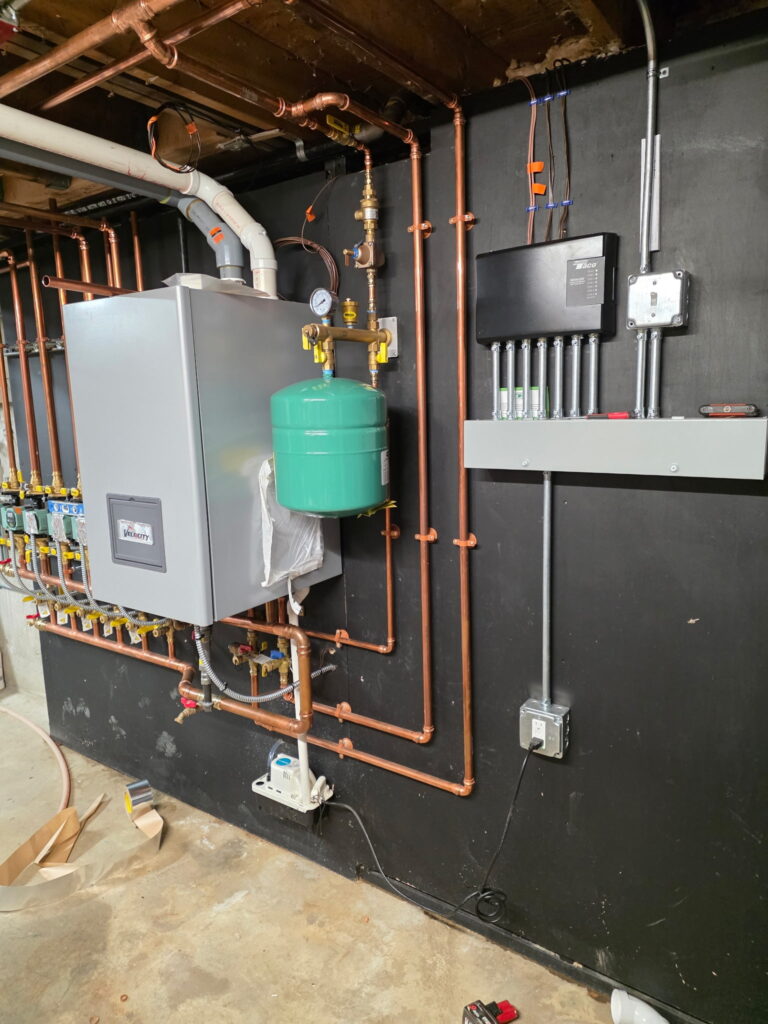
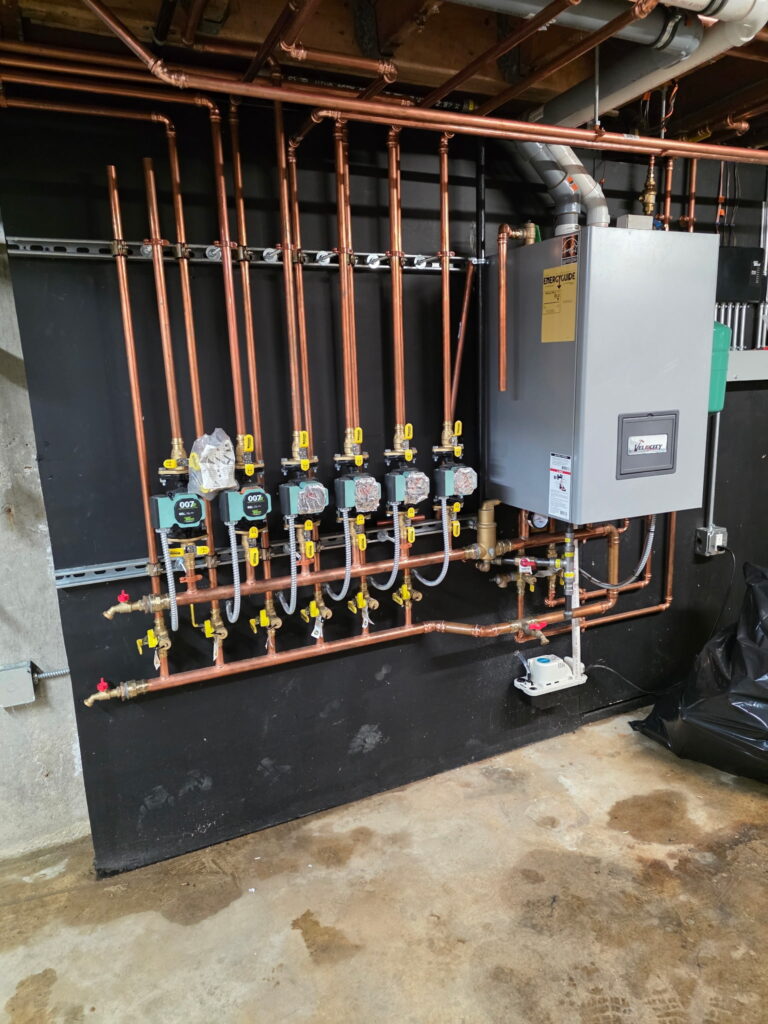
Boiler and water heater gas lines are bigger. We size the line based on the unit’s BTU input, which on an older steam boiler can be considerably higher than a modern high-efficiency replacement. If the existing line was sized for a smaller unit or an old atmospheric water heater, it often needs to be upsized before a new appliance can be safely connected. Venting gets checked at the same time, since gas code ties appliance venting and gas supply together, not just here but at the state level.
For a repair, the process starts with locating the failure. That’s usually a corroded joint, a cracked fitting behind a wall or in a crawlspace, or a line that was never properly bonded and is now showing wear at a connection point. We isolate the section, replace what’s compromised, pressure test the repaired section and the line downstream of it, and only then reconnect appliances. On most repair jobs the gas is off for a few hours, not days.
Repair or Replace
Most gas line problems in Beverly’s older homes are fixable without replacing the whole run. A leaking fitting, a corroded nipple, a section that’s failed at a joint, these get cut out and replaced in place. If the rest of the line is sound black iron in good condition, there’s no reason to touch it.
Full replacement makes sense when the line is undersized for a new higher-BTU appliance, when we find multiple points of corrosion along the same run suggesting the whole section is at the end of its life, or when a line was installed with materials or routing that wouldn’t pass inspection today. We’ll tell you straight which situation you’re in. If a repair holds and passes a pressure test, that’s what we recommend. Replacing a line that doesn’t need it doesn’t do you any favors, and it’s not how Chris runs the plumbing side of this business.
What It Costs
Cost depends on the length of run, whether it’s exposed or has to go through finished walls or ceilings, and whether you’re adding a new appliance or repairing an existing line. A simple range or dryer hookup with accessible piping is on the lower end. A boiler gas line upsize that involves opening a wall or running a longer distance from the meter costs more. We give you a number for your job before work starts, not a range that changes once we’ve opened the wall. Ask for {PRICE} specifics when we’re on site.
How Long It Takes
A standard appliance hookup or a single-joint repair is usually a same-day visit, often just a few hours including the pressure test. A full line replacement or a boiler gas line upsize that requires opening walls or running new pipe through the basement can take a full day, sometimes two if the routing is complicated by finished space. We’ll tell you the expected timeline before we start, including how long the house will be without gas to the affected appliance.
Common Questions
Is gas line work in Beverly permitted and inspected?
Yes. Gas line installation and repair requires a permit and inspection under Massachusetts gas code, regardless of the size of the job. We pull the permit and schedule the inspection as part of the work, not as an extra step you have to chase down.
How do I know if I have a gas leak?
The classic sign is a sulfur or rotten egg smell near an appliance or along a basement pipe run. You might also notice a hissing sound near a fitting, dead vegetation over an outdoor line, or a pilot light that won't stay lit. If you smell gas, leave the house, don't flip any switches, and call the gas utility's emergency line before calling us.
Can you run a gas line for a new range or dryer in an older Beverly home?
In most cases, yes, as long as gas service already reaches the house and the existing line has enough capacity. If the house is on oil or propane instead of natural gas, that's a bigger conversation we can walk you through before you buy the appliance.
Do you upsize gas lines for new high-efficiency boilers?
Often, yes. Many older Beverly homes have gas lines sized for a smaller or less efficient unit than what's available today. We calculate the new appliance's BTU input and size the line to match before installation, which is part of what makes a boiler swap take longer than people expect.
Will I be without gas during a repair?
Reach Out for Gas Line Installation and Repair
Belfiore Home Services is a Salem-based, licensed plumbing and electrical company, and we work across Beverly on gas line installation and repair for appliances, boilers, and water heaters. Call {PHONE} to talk through what you’ve got and get a straight answer on repair versus replacement.
Contact information
Talk to Chris
Chris runs the plumbing side of Belfiore Home Services and handles gas fitting work himself or oversees it directly. If you’re not sure whether what you’re dealing with is a repair or something bigger, describe what you’re seeing, a smell, a hissing sound, a pilot light that won’t hold, and he’ll walk you through what it likely means before anyone comes out.