
Boiler Installation and Replacement in Boxford, MA
A lot of Boxford homes are still running the boiler that came with the house, or the one installed the last time it failed in the middle of January. Between the older farmhouses, the estate-style properties on long driveways, and the mix of steam and hot water systems scattered across town, a straight answer about repair versus replacement is worth more here than almost anywhere else on the North Shore.
Boiler Installation and Replacement in Boxford
Boxford’s housing stock skews older and larger than most of its neighbors, and that shows up directly in the heating systems we find. Big, unevenly zoned houses with a boiler working harder than it should, additions tied into a system that was never sized for them, and mechanical rooms that haven’t been touched since the 1980s are all normal calls for us out here.
Chris handles the plumbing side of Belfiore Home Services, and boiler work is some of the most common high-ticket calls we get out of Boxford. It’s not a job people want to redo, so we walk through the actual condition of the equipment before we recommend anything.
What Boxford homes typically have
Boxford has a genuine mix of fuel types, and it varies street by street more than people expect. Some neighborhoods have natural gas mains running along the road. Others, especially the more rural sections and longer, private driveways, are oil-only or running on propane tanks. That single fact changes what a replacement boiler actually is, so we check gas availability before quoting anything, not after.
Water service is similarly split. A meaningful share of Boxford properties are on private wells rather than town water, which matters for boiler makeup water and for any indirect hot water tank tied into the system. On well water, mineral content and iron staining are common enough that filtration is a real conversation, not an add-on someone’s trying to sell you.
Heating-wise, we see plenty of older gravity-converted hot water systems and a real number of steam boilers, particularly in farmhouses and pre-1960s construction. Newer construction and additions tend to run modern hydronic hot water with zone valves or circulators. Knowing which one you have changes the entire scope of a replacement.
Repair or replace
This is the section we think matters most, because most people calling about a boiler have already braced themselves to hear “replace.” That’s not always the right answer, and Chris will tell you when it isn’t.
A boiler that’s heating unevenly because of a bad zone valve, a failed circulator, or a stuck aquastat is a repair, not a replacement, even if the unit is fifteen or twenty years old. Steam boilers with noisy pipes or short-cycling are frequently a near-boiler piping or main vent issue, not a sign the boiler itself is done. If the heat exchanger is sound, the flue is drafting properly, and there’s no active leak in the block, keeping it running is usually the honest recommendation.
Replacement makes sense when the heat exchanger is cracked or leaking, when the boiler is significantly oversized or undersized for the house, when efficiency has dropped enough that fuel bills don’t match the size of the home, or when a fuel conversion (oil to gas or oil to propane) is on the table for a Boxford property near a gas main. We’ll tell you which category you’re in and why, in plain terms, before you commit to anything.
What the work involves
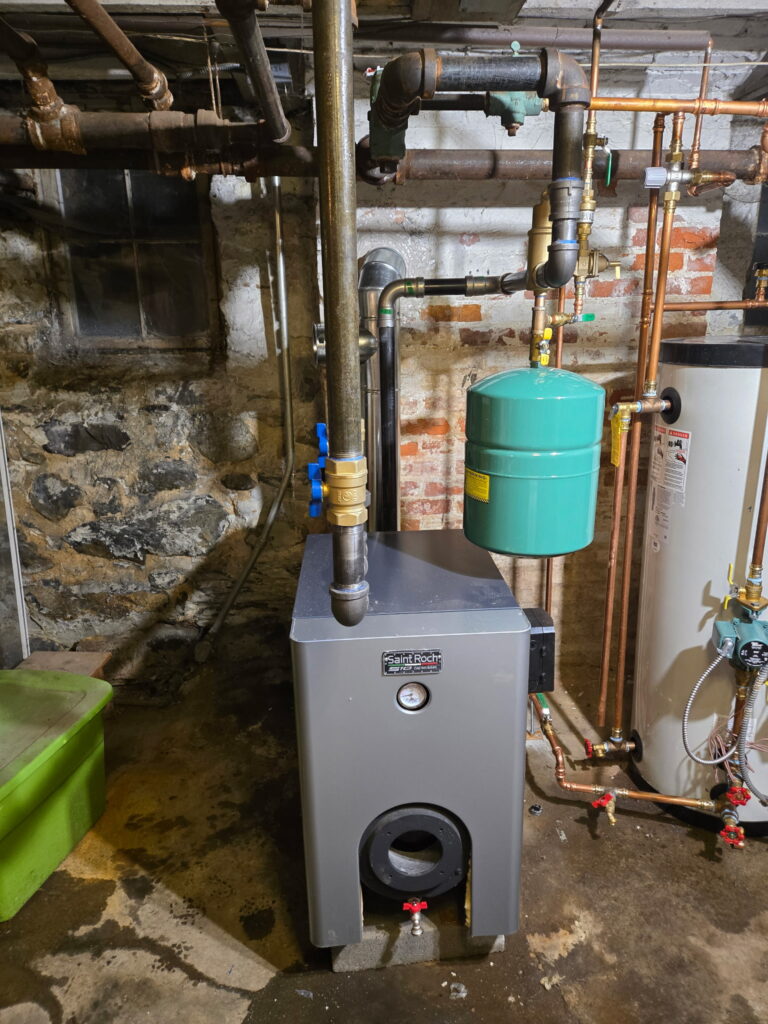
A boiler replacement starts with draining the existing system, disconnecting the old unit, and removing it, along with any near-boiler piping that isn’t being reused. From there, the new boiler is set, piped to the existing distribution (or re-piped where the old layout doesn’t match modern code), and connected to venting sized correctly for the new unit, whether that’s a traditional chimney liner or a sidewall power vent on a high-efficiency model.
Gas boilers need the gas line sized and verified against the new unit’s BTU input, which sometimes means upsizing the branch line from the meter. Oil boilers need the burner nozzle and firing rate matched to the new heat exchanger. Steam boiler replacements require careful attention to near-boiler piping dimensions, since undersized piping is the single biggest cause of steam boiler problems after installation.
Once the new boiler is set and piped, we fill and bleed the system, fire it, check for leaks, and let it run through a full cycle to verify even heat across the zones before we call it done. On systems with an indirect hot water tank, we confirm recovery and temperature at the tap before we leave.
What it costs
Boiler replacement cost depends on fuel type, whether venting needs to change, whether the near-boiler piping is being redone, and whether an indirect hot water tank is part of the job. A straightforward like-for-like gas boiler swap costs differently than a steam-to-hot-water conversion or an oil-to-gas fuel switch tied into a new gas line. We give you a firm number for your specific house and system, in writing, before any work starts, and we explain what’s driving that number so it doesn’t feel like a guess.
How long it takes
A standard boiler replacement on an existing system, same fuel type and same venting, typically runs a single day, with the house back on heat by evening. Add a fuel conversion, a chimney liner install, or unusual near-boiler piping on an older steam system, and the job can run into a second day for startup, balancing, and final checks. On Boxford properties with wells, we also confirm the makeup water connection is functioning properly before we consider the job complete.
Common Questions
Is Boxford mostly oil heat or is gas available?
It depends on the road. Some Boxford neighborhoods have natural gas at the street, others are oil-only or propane. We check availability before we quote anything, because it changes whether replacement means a gas boiler, an oil-fired unit, or a switch to propane.
How long will my house be without heat during a boiler swap?
Most straightforward replacements are one day, sometimes bleeding into a second morning for startup and balancing. Systems with unusual piping, asbestos-era insulation to work around, or a fuel conversion take longer. We tell you which one you have before we start.
My boiler is old but still runs. Should I replace it now?
Not necessarily. If it's heating evenly, not leaking, and the flue and controls are sound, Chris will tell you to keep running it and put the money toward something else. We size up replacement recommendations against what's actually failing, not the age on the nameplate alone.
Do you work on steam boilers, not just hot water?
Yes. Boxford has a fair number of older steam systems, especially in farmhouses and homes built before the 1960s. Steam and hot water (hydronic) systems are sized and vented differently, and we handle both.
Can a new boiler also solve inconsistent hot water?
Reach Out for Boiler Installation and Replacement
If your boiler is short-cycling, leaking, or just old enough that you’re wondering what’s next, call {PHONE} and we’ll talk through what you’re actually dealing with. No pressure to replace something that’s still doing its job, and a straight answer when it isn’t.
Contact information
Talk to Chris
Chris looks at boiler photos and answers straightforward questions before you commit to a full estimate. If you’re not sure whether your system needs a repair or a full replacement, that’s exactly the kind of call worth making first. We’re a Salem-based company and we work across Boxford regularly, so we know the fuel-type split and the older housing stock here well.