
Recessed Lighting Installation in Salisbury, MA
A lot of Salisbury houses were built with a couple of ceiling fixtures per room and not much else, because that’s what people needed in the 1960s and 70s. Now you’re finishing a basement, redoing a kitchen, or just tired of one dim overhead bulb trying to light an entire living room, and the existing wiring was never laid out for the kind of even, layered light recessed cans give you.
Recessed Lighting Installation in Salisbury
Belfiore installs recessed lighting in Salisbury homes as part of remodels, basement finishes, and straightforward upgrades where someone just wants better light in a room that’s always felt dark. Brandon handles the electrical side start to finish – running new circuits where needed, cutting in the housings, and making sure the whole job passes inspection the first time.
This isn’t specialty work in the sense of being rare. It’s specialty work in the sense that it has to be done right, or you end up with cans that hum, dim unevenly, or trip a breaker every time you turn on the dishwasher.
Why Salisbury homes need this
Salisbury’s housing stock is mixed. You’ve got older beach-area cottages that started as seasonal camps and got winterized and added onto over the decades, plus a good number of mid-century ranches and capes further inland. Neither type was wired with recessed lighting in mind.
In the older seasonal-turned-year-round homes, it’s not unusual to find cloth-insulated wiring or sections that were patched by whoever owned the place in 1975, sometimes without a permit. Panels in this age bracket are frequently 60 or 100 amp, and in a few cases we still see Zinsco or Federal Pacific panels that carry known safety issues and aren’t rated for the way a modern household actually pulls power – AC units, electric ranges, EV chargers, and now added lighting circuits all on top of what was already a tight service.
The mid-century ranches are usually in better shape electrically, but they still weren’t built with the ceiling framing or the insulation clearances that today’s LED recessed fixtures need. Add blown-in insulation from an energy retrofit years back, and now you’ve got a ceiling cavity that has to be worked around carefully so the fixtures stay IC-rated compliant and don’t become a heat problem.
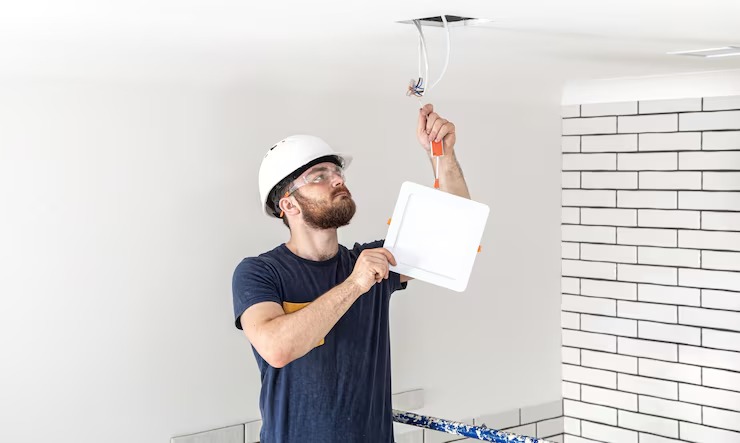
What the work involves
Brandon starts by opening the ceiling from below where possible, so we’re not tearing into finished walls unless the layout demands it. From there:
- The circuit gets mapped – is there room on an existing circuit, or does this need its own dedicated run back to the panel
- New cable gets fished through the ceiling cavity, sized correctly for the load (typically 14 or 12 gauge depending on the breaker)
- Housings get cut in and secured to joists or mounted with bar hangers between them
- Fixtures get wired, trimmed, and connected to a switch – often a dimmer, since that’s most of the reason people upgrade to recessed lighting in the first place
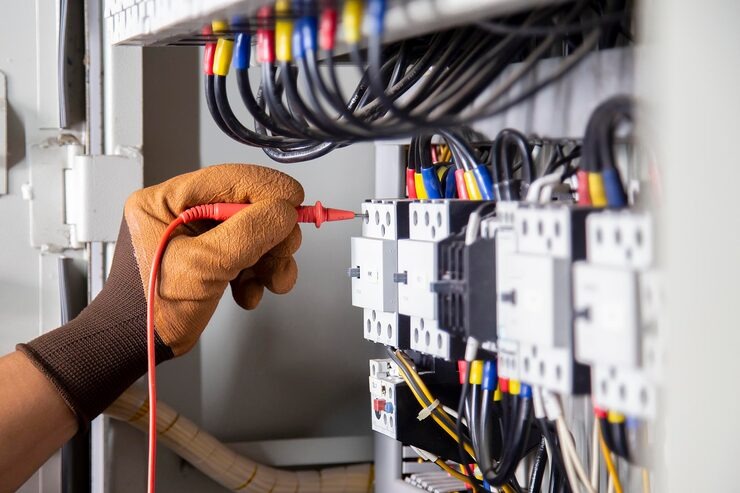
- The circuit gets tested under load before we call it done
Power to the work area is off for the duration of the job, usually just that circuit rather than the whole house. If the panel itself needs attention – a full or aging panel that can’t take another breaker – the utility has to schedule a temporary disconnect on their end for anything involving the meter or service drop. That’s their job, not ours, and it’s something we flag up front if we see it coming.
What It Costs
A basic recessed lighting installation in Salisbury – four to six fixtures on an existing circuit with a dimmer – typically runs {PRICE_LOW} to {PRICE_HIGH}. What moves that number: how many fixtures, whether you need a new dedicated circuit, how hard the ceiling is to access (finished ceiling versus open joists in a basement), and whether the panel has room to take the new circuit without an upgrade.
We’ll give you a firm number after Brandon looks at the panel and the ceiling, not a phone estimate. Ceiling access is the biggest wildcard – a plaster ceiling in an older Salisbury cottage takes longer to work through cleanly than an open-joist basement.
How long it takes
Most recessed lighting jobs in a single room – a kitchen, living room, or basement rec area – take one day. If the job needs a new dedicated circuit run back to the panel, or if the panel itself needs upgrading to handle the added load, plan on it taking longer, sometimes spread across two visits if a permit inspection has to happen in between.
Permits and inspection
Recessed lighting installation is electrical work under the Massachusetts electrical code, and it gets permitted and inspected like any other circuit work. Brandon pulls the permit, the town inspector signs off on the rough-in before the ceiling closes up (if it’s an open-ceiling job) or on the finished work, and you get a paper trail showing the work was done to code.
That matters more than people think. Unpermitted electrical work is common with unlicensed installers, and it becomes a real problem at resale or if there’s ever a fire claim and the insurance company asks for permit history. A licensed electrician pulling permits is the difference between having proof the work is safe and just hoping it is. [EXTERNAL LINK: Massachusetts Board of State Examiners of Electricians – electrical permit and licensing requirements]
Common Questions
Can recessed lighting be added without opening up my whole ceiling?
In most cases, yes. Brandon can fish cable through the ceiling cavity and cut in housings from small access holes rather than removing the whole ceiling. Plaster ceilings in older Salisbury homes sometimes need a bit more care, but full teardown is rarely necessary.
Do I need a new circuit for recessed lighting?
Not always. If your existing lighting circuit has capacity, we can often add fixtures to it. If the panel is already tight – which is common with older 60 or 100 amp services in Salisbury – a dedicated circuit or panel upgrade may be the better move, and Brandon will tell you which applies before starting.
Are LED recessed lights required now?
Massachusetts energy code pushes strongly toward high-efficiency fixtures, and LED recessed housings are the standard install at this point. They also run cooler, which matters in ceilings with blown-in insulation.
How many recessed lights does a typical room need?
It depends on room size and ceiling height, but a standard living room or kitchen usually runs four to eight fixtures spaced for even coverage. Brandon will lay out a plan based on the room, not a generic grid.
Will the power be off during installation?
Just the circuit being worked on, for most of the job. Whole-house outages are rare and only happen if panel work is involved.
Reach Out for Recessed Lighting Installation
If you’re planning a remodel in Salisbury or just want to finally light a room properly, get in touch. We’ll look at what you’ve got, tell you what it’ll take, and give you a real number before any work starts. Call {PHONE} to get on the schedule.
Contact information
Talk to Brandon
Brandon’s the licensed electrician at Belfiore, and he’s the one who’ll walk your ceiling, check your panel, and tell you straight whether your existing circuits can handle new recessed lighting or whether you need more. Call {PHONE} and he’ll set a time to come look at the space in person.