
Recessed Lighting Installation in Reading, MA
Most of Reading was built out in waves from the 1950s through the 1970s, with capes and colonials on lots big enough that additions and finished basements have been a steady project type ever since. Those houses came with a 100 amp panel and a handful of ceiling boxes per floor, never a lighting plan for the open-concept kitchen remodel or the basement rec room someone’s finishing now.
Recessed Lighting Installation in Reading
Recessed lighting is one of those upgrades that changes a room without changing the footprint. Drop a row of 4-inch or 6-inch cans over a kitchen island, layer in some 2700K wafer lights in a finished basement ceiling, or replace a single flush-mount fixture in a living room with six evenly spaced lights on a dimmer. Brandon handles the whole job: layout, wiring, cutting, trim, and the switch or dimmer at the wall.
This is work Brandon genuinely likes doing. It’s clean, visual, and the difference between a house before and after is obvious the first night you turn the lights on.
Why Reading homes need this
The wiring in a lot of Reading’s older housing stock was never designed for the lighting load people want now. Homes from the 1950s and early 60s sometimes still have knob-and-tube segments in ceilings or attics that were never fully removed during past renovations, and cloth-insulated branch circuits from that era don’t hold up well to being spliced into repeatedly. A 60 amp or early 100 amp service was fine for a few lamps and a refrigerator. It’s not fine once you’ve added a heat pump, an EV charger, and eight new can lights on the same panel.
We also still run into Federal Pacific Stab-Lok and Zinsco panels in this area, both of which have known breaker failure issues that go beyond just being old-fashioned. If your panel is one of these, Brandon will tell you before we run a single new circuit, not after, because adding load to a panel that doesn’t trip reliably is a real safety issue, not a sales pitch.
Reading’s mix of post-war ranches, capes, and larger colonials on generous lots is exactly the kind of housing stock now taking on EV chargers, heat pump air handlers, and finished basements all at once. Recessed lighting is often the smallest part of that project, but it still needs a properly sized circuit, not a tap off an existing overloaded one.
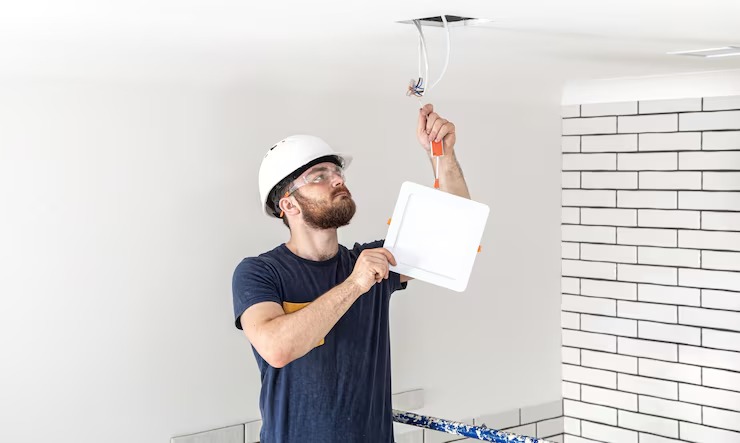
What the work involves
Before anything gets cut, Brandon maps out the fixture layout with you and checks what circuit it’s landing on. If the room is on an older circuit already carrying other loads, we’ll usually run a new dedicated 15 or 20 amp circuit back to the panel rather than daisy-chain more fixtures onto something that’s already close to its limit.
The power to that section of the house gets shut off at the breaker for the install, typically a few hours depending on how many fixtures and how much ceiling access there is. This isn’t a utility-involved job in most cases. National Grid or Reading Municipal Light Department only gets involved if the job requires a full service upgrade to support the added load, which does happen when a homeowner is adding recessed lighting as part of a bigger project that also includes an EV charger or panel upgrade.
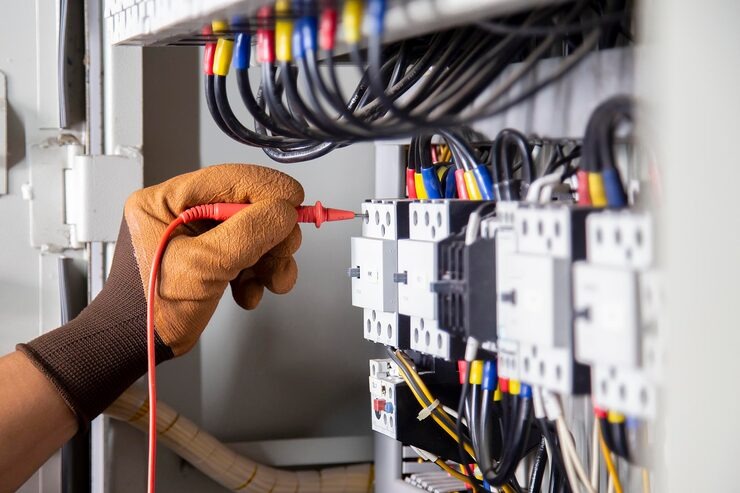
Brandon cuts the housings, runs new cable through the joist bays or attic space, wires each fixture, and installs a dimmer switch when that’s part of the plan. Every new circuit gets tested for proper amperage draw before we close anything up, and if the job included any panel work, that gets a load calculation too.
What It Costs
A straightforward recessed lighting job in Reading, replacing an existing fixture or two, or adding four to six cans on an existing circuit, generally runs {PRICE_LOW} to {PRICE_HIGH}. Cost moves with the number of fixtures, whether you need a new dedicated circuit versus tying into an existing one, ceiling access (open basement joists are much faster than a finished plaster ceiling), and whether a dimmer or smart switch is part of the scope.
Jobs that turn up an FPE or Zinsco panel, or knob-and-tube feeding the area you want lit, cost more because that has to be addressed first. Brandon will always walk you through what’s driving the number before he starts, not after.
How long it takes
A single room, six to eight recessed fixtures on an existing or new dedicated circuit, is typically a one-day job. Larger projects like a full basement finish with a dozen or more fixtures across multiple rooms can run two days, especially if that includes new switches, dimmers, or a subpanel to handle the added circuits.
Permits and inspection
Recessed lighting installation is electrical work under Massachusetts code, which means it gets a permit and an inspection, not a handshake. Brandon pulls the permit through the Town of Reading, does the work to code, and the inspector signs off before the ceiling gets closed up for good. That inspection step is what separates a licensed electrician from someone working off the books, and it’s the reason the job holds up when you go to sell the house or file an insurance claim down the line. [EXTERNAL LINK: Massachusetts Electrical Code (527 CMR 12) reference from Mass.gov, for homeowners who want to see the actual standard the work is inspected against]
Common Questions
Can recessed lighting go on my existing circuit, or do I need a new one?
It depends what else is on that circuit. If it's already running a lot of other outlets or appliances, Brandon will usually recommend a new dedicated circuit rather than adding more load to something near its limit.
Do I need a permit for recessed lighting in Reading?
Yes. It's electrical work under Massachusetts code, so it gets permitted through the Town of Reading and inspected before the ceiling is closed up.
How many recessed lights can I put on one circuit?
It depends on the wattage of the fixtures and the breaker size, but a typical 15 amp circuit has real limits. Brandon calculates the actual load before recommending a layout so you're not tripping breakers.
My house has an FPE panel. Can I still add recessed lighting?
You can, but Brandon will flag it first. Federal Pacific panels have known breaker reliability issues, and adding new circuits to one isn't something we do without a conversation about the panel itself.
Will installing recessed lighting mean the power is out all day?
Usually just for the section of the house being worked on, and typically for a few hours rather than all day, though larger multi-room jobs take longer.
Reach Out for Recessed Lighting Installation
If you’re planning a kitchen remodel, finishing a basement, or just tired of one dim overhead fixture doing all the work in a room, call {PHONE} to get Brandon out to look at the space. We work across Reading and the rest of the North Shore, and we’ll give you a straight answer on what the room needs and what it’ll cost.
Contact information
Talk to Brandon
Brandon’s the one who’ll walk your ceiling, tell you what circuit makes sense, and flag anything about your panel or wiring that needs attention before the lighting job starts. He’s licensed, he pulls the permit, and he’s the one on the ladder, not a sub.