
Outlet and GFCI Installation and Repair in Andover, MA
A lot of Andover homes near the town center still have two-prong outlets from a 60 or 100 amp service, tucked into plaster walls that were never touched after the original build. Out toward the newer developments off River Road and near the Shawsheen area, houses have modern panels but kitchens and baths that still weren’t wired to today’s GFCI standard when they went in. Either way, the fix is the same kind of job: swap what’s there for outlets rated for how the house is actually used now.
Outlet and GFCI Installation and Repair in Andover
This is one of the most common calls Brandon gets in Andover, and one of the least dramatic. Nobody’s losing heat or waiting on hot water. It’s usually a dead outlet in a laundry room, a GFCI that trips every time the microwave and coffee maker run together, or a homeowner mid-renovation who’s been told by their contractor that the electrical needs to be brought up before drywall goes back up. We treat it the same way whether it’s one outlet or a whole-house pass: check the circuit, check the panel it feeds, fix it right instead of patching around it.
Why Andover homes need this
Andover is the far edge of where we work, and the housing stock reflects a town that’s been built up in waves. The historic center has homes from the 1800s and early 1900s with knob and tube wiring still live in some walls, cloth-insulated conductors that have gone brittle, and original 60 amp services that were adequate for a few lamps and a radio, not a modern kitchen. Some of those houses still have Federal Pacific or Zinsco panels from later upgrades done in the 60s and 70s – both brands with known breaker problems that don’t trip reliably under fault conditions.
Then there’s the newer stock: colonials and capes from the postwar boom, and the larger modern builds from the last two decades in the developments off Lowell Street and Salem Street. These houses usually have adequate service size, but bathrooms and kitchens built or last updated before the mid-90s often don’t have GFCI protection where code now requires it. Andover’s strong remodel market makes this come up constantly – open a wall for a kitchen renovation and you find outlets that need to move, add, or get GFCI protection before an inspector will sign off.
What the work involves
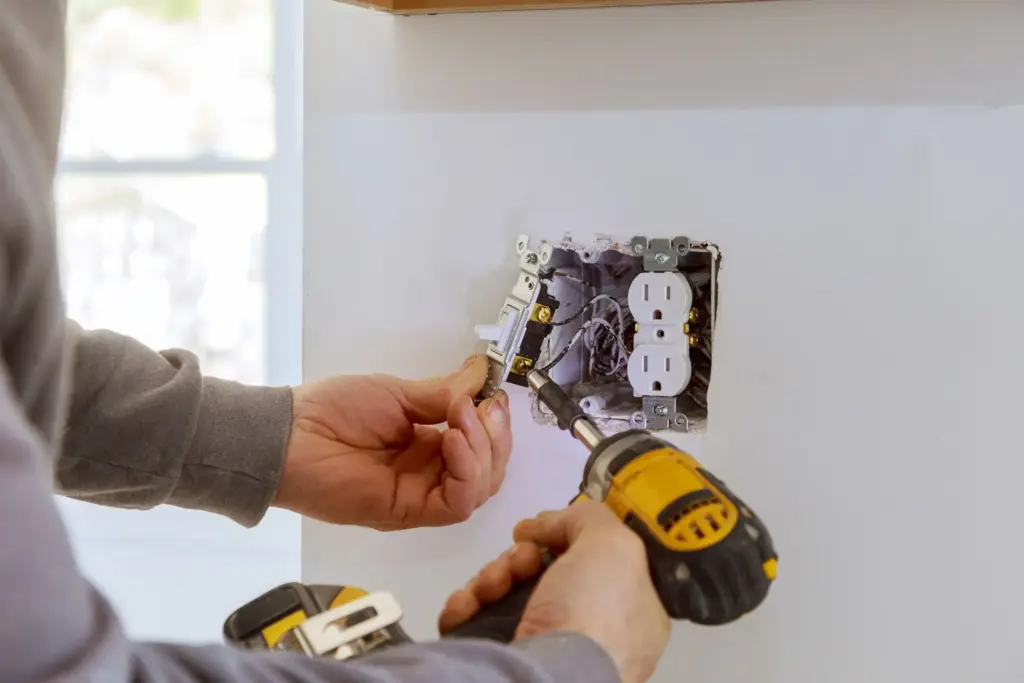
For a straightforward outlet swap or GFCI install, Brandon kills power to the circuit at the panel, confirms it’s dead with a tester, and pulls the old device. If the box is grounded and the wire gauge is right for the circuit, the new outlet or GFCI goes in, gets tested, and the circuit’s back on in minutes. Power to that specific circuit is out for the length of the job, not the whole house.
It gets more involved when the wiring behind the wall isn’t up to it. Ungrounded circuits, aluminum branch wiring, or knob and tube feeding the box changes the job from a swap to a repair. In those cases Brandon explains the options on the spot: run new copper to that outlet, install a GFCI with no-ground labeling where a full rewire isn’t in scope, or flag it if the bigger issue is the service size itself. He doesn’t decide that without you standing there looking at it with him.
Anything involving the utility’s side of the meter, like a service size increase, is coordinated separately with National Grid. The panel and branch circuit work inside the house is ours; the meter and service drop are theirs.

What It Costs
A single outlet or GFCI replacement runs {PRICE_LOW} to {PRICE_HIGH} in most Andover homes, and that range covers straightforward, accessible swaps. What moves the number: how many devices need doing at once, whether the box needs to be replaced or relocated, whether the wiring behind it is grounded copper or something older that needs correcting, and how much drywall or plaster repair is involved if a run needs to be extended. Bathroom and kitchen GFCI circuits sometimes need an added dedicated circuit if the existing one is overloaded, which is priced separately. Brandon gives you the number before anything gets opened up, not after.
How long it takes
A single outlet or GFCI swap is usually a same-visit job, often under an hour once Brandon’s on site. A whole-house pass, common in the older homes near the town center where multiple outlets need grounding or GFCI upgrades, can run a full day depending on how many circuits are involved and how much of the original wiring has to be traced. If knob and tube or aluminum wiring turns up mid-job, that can extend the timeline since it changes the scope from a repair to a partial rewire.
Permits and inspection
Electrical work in Massachusetts requires a permit pulled by a licensed electrician, and GFCI and outlet work is no exception once it goes beyond a like-for-like swap of a single device. Brandon pulls the permit, does the work to the Massachusetts Electrical Code (which adopts the National Electrical Code with state amendments), and the town’s inspector signs off before the work is closed out. This is the part that separates a licensed job from a handyman fix: an inspector has actually looked at the grounding, the box fill, and the circuit before it’s called done. [EXTERNAL LINK: Massachusetts Board of State Examiners of Electricians – state electrical code and licensing information]
Common Questions
Do I need a permit just to replace one outlet?
A direct like-for-like replacement of a single device sometimes doesn't require a separate permit, but any work involving GFCI upgrades, rewiring, or box changes does under Massachusetts law. Brandon will tell you which category your job falls into before starting.
Why does my GFCI keep tripping?
Usually it's a downstream fault, a moisture issue, or too many appliances sharing one GFCI-protected circuit. Sometimes it's just an old GFCI device that's worn out and needs replacing. It's worth having it checked rather than resetting it repeatedly.
My house doesn't have grounded outlets. Can you still add GFCI protection?
Yes. Where a full rewire isn't in scope, a GFCI can be installed on an ungrounded circuit with a required no-ground label, which restores shock protection without pretending the wiring is grounded when it isn't.
What's the difference between a GFCI and a regular outlet?
A GFCI outlet monitors current and shuts off power in a fraction of a second if it detects a ground fault, which is what protects you near water. Code requires them in kitchens, bathrooms, garages, and other specific locations.
Do you work on older wiring like knob and tube?
Reach Out for Outlet and GFCI Installation and Repair
Andover is the farthest town we cover from our Salem base, so we’re upfront that visits here are scheduled rather than same-hour. Call {PHONE} and we’ll find a time that works, walk through what you’re dealing with, and get Brandon out to look at it properly.
Contact information
Talk to Brandon
Brandon’s the licensed electrician at Belfiore. He left union work to do this full time with his brother, and outlet and GFCI calls like these are a big part of what he does week to week across the North Shore, Andover included. If you’ve got a tripping GFCI, a dead outlet, or a renovation that surfaced old wiring you didn’t know about, tell him what you’re seeing and he’ll tell you straight whether it’s a quick fix or something bigger.