Generator Installation and Connection in North Andover, MA
Generator Installation and Connection in North Andover
A lot of North Andover homes still run on the electrical service they were built with, whether that’s a 1960s colonial near the town common or a newer build off Boston Street with a finished basement full of gear that wasn’t part of the original plan. When the power goes out for a day and a half after a nor’easter, you find out fast whether your house can run the well pump, the sump pump, the furnace, and the fridge at the same time. It usually can’t, not without help.
Brandon installs and connects standby and manual-transfer generators for homes across North Andover, sized to the panel and the loads that actually matter to your household, not a generic package.
Why North Andover Homes Need This
North Andover splits into two very different electrical realities. The historic center and older neighborhoods near the common often still have 100 amp services, and some older colonials haven’t been touched since a 60 amp upgrade decades ago. A handful of these homes still carry cloth-insulated wiring or a panel that was never designed for today’s load – Federal Pacific Stab-Lok panels turn up here often enough that we check for them on every generator quote, since a breaker that won’t trip is a real hazard once you’re adding standby load.
On the other side of town, the post-war and newer construction near Sutton Street and the west side of Route 125 tends to have 200 amp services and better bones, but those homes are also mid-remodel more often than not – additions, finished basements, new kitchens with induction ranges and second refrigerators. Every one of those additions pulls more from a grid that already goes down during coastal storms. A generator isn’t a luxury item in this town. It’s what keeps the well pump and heating system running when the lines come down off the Merrimack Valley circuits, which happens most winters.
What the Work Involves
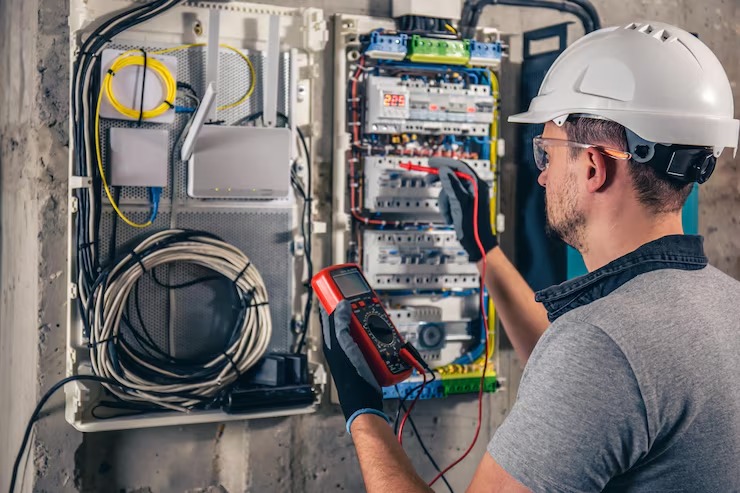
For a standby unit, Brandon sets the generator on a pad outside, runs gas or propane fuel line to it, and wires it to an automatic transfer switch installed next to your main panel. The transfer switch is what senses a utility outage and switches your house to generator power automatically, usually within about 10 seconds, then switches back once utility power is stable.
Your power is shut off for the connection itself, generally a few hours, not a full day. The utility – National Grid in most of North Andover – has to inspect and sometimes upgrade the service drop or meter before a larger generator can be tied in, and that scheduling is separate from the electrical work and outside our control. On the electrical side, Brandon confirms your panel’s amperage and breaker capacity, sizes the transfer switch to your actual circuits (whole-house or a selected sub-panel of critical loads), and runs the wiring gauge appropriate to the generator’s output, typically 6 or 4 AWG for a 20-22kW unit. For manual setups, we install a properly interlocked transfer kit rather than a suicide cord and inlet box, which is the unsafe shortcut some unlicensed installs still use.
What It Costs
A straightforward whole-house standby generator installation in North Andover, including the transfer switch and electrical connection, generally runs {PRICE_LOW} to {PRICE_HIGH}. That figure moves with panel condition, distance from the panel to the generator pad, whether your service needs upgrading first, and whether you’re running whole-house or a critical-loads sub-panel. A manual transfer switch setup for a portable generator costs less than an automatic standby system, since there’s no monitoring hardware or automatic switching gear involved. The generator unit itself is typically quoted separately by the manufacturer or distributor – what Brandon prices is the electrical connection, transfer equipment, and any panel work needed to support it. We’ll tell you plainly if your existing panel needs to be upgraded before a generator can go in safely, rather than connecting a new unit to an old, undersized panel.
How Long It Takes
Most standby generator installations take one full day for the electrical connection once the pad, gas line, and generator itself are in place. If your panel needs replacing first, or if the utility requires a service upgrade before the transfer switch can be tied in, plan on the project spanning a few separate visits: one for panel work, one for the utility’s inspection and upgrade, and one for the final connection and startup test. Manual transfer switch installs are usually a half-day job on their own.
Permits and Inspection
Generator installations are permitted work in Massachusetts. Brandon pulls the electrical permit, and the town inspector signs off on the transfer switch wiring, grounding, and panel work before the system goes live. This isn’t paperwork for its own sake – an unpermitted generator connection is one of the more common things a home inspector flags at resale, and it’s also how you end up with a transfer switch that was never checked against the [EXTERNAL LINK: Massachusetts electrical code (527 CMR) for backup power and transfer switch requirements]. If you’re adding propane or natural gas fuel line, that piece gets its own permit and inspection as well.
Common Questions
Can my current electrical panel support a standby generator?
It depends on the panel's condition and amperage. Many older North Andover homes have 100 amp services, which can often work with a properly sized transfer switch, but a Federal Pacific or Zinsco panel typically needs replacing first for safety reasons regardless of the generator.
Do I need a whole-house generator or will a smaller unit work?
Most households don't need every circuit backed up. Brandon usually recommends sizing to a critical-loads sub-panel – heat, well or sump pump, refrigerator, some lighting and outlets – which costs less than a full whole-house system and still covers what actually matters during an outage.
How is a standby generator different from the portable one I already own?
A portable generator needs to be manually connected through an interlock kit or transfer switch and requires you to be home to start it. A standby unit is wired into your electrical system permanently, runs on natural gas or propane, and starts itself within seconds of an outage.
Will the gas or propane line for the generator need a separate permit?
Yes. Fuel line work is inspected separately from the electrical connection. Both need to be signed off before the system is approved to run.
How long does North Andover typically lose power during a storm?
It varies by storm and by which circuit feeds your street, but coastal nor'easters and ice storms have knocked out power in parts of North Andover for a day or more in past years, which is the main reason standby generator demand runs high here.
Reach Out for Generator Installation
We work across North Andover and the rest of the North Shore. North Andover sits at the western edge of our footprint, farther from Salem than most towns we serve, so we schedule generator work here with that travel built into the plan rather than promising a same-hour arrival. Call {PHONE} to get a time on the calendar and a straight answer on what your home’s panel can handle.
Contact information
Talk to Brandon
Brandon is the licensed electrician side of Belfiore. He’ll walk your panel, tell you straight whether it can support a generator as-is or needs an upgrade first, and size the system to what actually matters in your house – heat, water, and the basics – instead of overselling a bigger unit than you need.