
Electrical Troubleshooting and Repair in Georgetown, MA
Georgetown has a lot of farmhouses and colonials that started life with a 60 amp service and a couple of circuits for lights and a stove. Sixty or eighty years later, that same panel is now feeding a well pump, a furnace, a couple of window units, and every phone charger in the house. Something has to give, and usually it gives at the worst time.
Why Georgetown Homes Need This
A good number of the older houses off Route 97 and out toward East Main Street were built well before central air, well pumps, and modern kitchens were part of the plan. The electrical service was sized for a much smaller load, and it shows. We still find knob and tube wiring behind plaster walls in Georgetown, cloth-insulated cable that has gone brittle, and panels branded Federal Pacific or Zinsco that were pulled off the market decades ago for a reason – the breakers don’t always trip when they should.
Add in well and septic systems, which are common out here and put real demand on a panel that a city house never has to deal with, and you get nuisance trips, flickering lights, and outlets that just stop working. Georgetown also loses power for stretches during nor’easters and ice storms, which is why so many homeowners are asking about generator hookups and interlock kits on top of basic repairs. That’s not a separate problem – it’s usually the same aging panel driving both conversations.
What the Work Involves
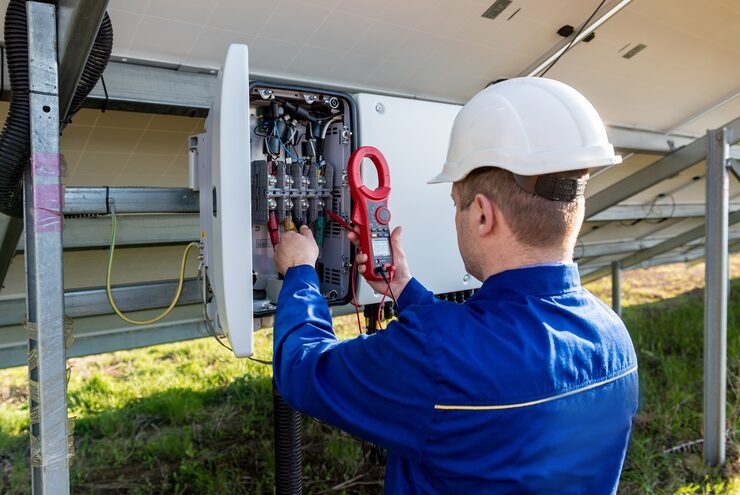
Every troubleshooting call starts the same way: figure out what’s actually wrong before touching anything. Brandon traces the circuit, checks the panel for loose lugs, corroded bus bars, or double-tapped breakers, and tests for continuity and voltage drop at the outlet or fixture that’s acting up. Half the time the fix is a bad connection or a failed breaker. The other half, it’s wiring that’s simply outdated for the load it’s carrying.
If the fix requires shutting off power, it’s usually just the affected circuit or the whole panel for a short window – often under an hour for a repair, longer if a breaker or section of wire needs to be replaced. Anything involving the service itself, the wires coming from the pole or transformer to the house, is the utility’s job, not the electrician’s. Brandon handles everything from the meter inward. Once the repair is made, he tests the circuit under load before calling it done, not just checking that the light comes on.
What It Costs
Straightforward troubleshooting and repair in Georgetown generally runs between {PRICE_LOW} and {PRICE_HIGH}. A single bad breaker or a loose connection at an outlet sits at the low end. A job that turns into replacing a run of knob and tube, pulling new circuits for a well pump, or addressing a panel that’s showing real wear costs more, and Brandon will tell you that on site before doing the work, not after.
What moves the number is mostly how much of the house the problem touches. One outlet is a quick visit. A whole circuit that’s been overloaded for years, or a panel that needs more than a breaker swap, takes more time and material. You’ll get a number before anything gets opened up.
How Long It Takes
Most troubleshooting visits in Georgetown wrap up in one to two hours. That covers diagnosis and a straightforward fix – a breaker, a switch, a receptacle, a loose neutral. If the problem turns out to be old wiring that needs to be replaced in a wall or a section of the panel that needs work, Brandon will say so and give you a realistic timeline before starting, rather than opening walls and figuring it out as he goes.
Permits and Inspection
Electrical repair work in Massachusetts is permitted and inspected, same as new construction. Anything beyond swapping a breaker like-for-like or replacing a fixture generally needs a permit pulled with the town and a sign-off from the local inspector once the work is done. Brandon handles that paperwork as part of the job. It’s an extra step, but it’s the difference between a licensed electrician’s work and a handyman’s – the town has a record that the job was done to code, and you have a record for insurance and resale. [EXTERNAL LINK: Massachusetts Electrical Code (527 CMR 12) overview from the Board of State Examiners of Electricians, for homeowners who want to see the standard the work is held to]
Common Questions
Is my Georgetown home's wiring old enough to be a problem?
If your house was built before the 1970s and hasn't had an electrical upgrade, there's a real chance of knob and tube wiring, a 60 amp service, or an older panel brand like Federal Pacific or Zinsco. None of these are automatically dangerous, but they all limit what you can safely add to the system, and they're worth having looked at.
Why do my lights flicker when the well pump turns on?
That's usually a sign the circuit feeding the pump is undersized or sharing a load it shouldn't be, or that there's a loose connection somewhere in the panel. It's common in Georgetown homes with well systems added after the original wiring was installed, and it's worth having checked rather than living with it.
Do I need a permit for a simple repair like replacing a breaker?
A straightforward like-for-like breaker or fixture swap usually doesn't need a separate permit. Anything that changes wiring, adds a circuit, or touches the panel in a more significant way does, and Brandon will tell you which category your job falls into before starting.
Can you fix the problem without replacing my whole panel?
Often, yes. Plenty of issues are a single bad breaker, a loose neutral, or a failed connection that doesn't require touching the rest of the panel. Brandon diagnoses first and only recommends a bigger job, like a panel upgrade, when the panel itself is actually the problem.
How long will my power be off during a repair?
For most circuit-level repairs, it's under an hour and only affects the circuit being worked on. If the whole panel needs to be de-energized for a more involved repair, Brandon will tell you the expected window before starting.
Reach Out for Electrical Repair
If you’re dealing with a breaker that won’t stay reset, an outlet that’s gone dead, or lights that dim when the well pump kicks on, call {PHONE}. Brandon will walk you through what he can tell over the phone and get a visit scheduled to see the panel and the affected circuits in person.
Contact information
Talk to Brandon
Brandon is the electrician half of Belfiore. He left union work to run the electrical side of his brother’s plumbing and heating company, and he’s the one who shows up to look at your panel or trace down why a circuit keeps tripping. He’s licensed, he pulls permits, and he’ll tell you straight whether something’s a quick fix or the first sign of a bigger issue with the service.