Electrical Panel Replacement in Peabody, MA
A lot of Peabody’s housing went up between the 1900s and the 1950s, back when a house ran on 30 or 60 amps and that was plenty for a few lamps, a radio, and an icebox. Somewhere along the way that same house picked up central air, a finished basement, a hot tub, maybe an EV in the driveway, all feeding through a panel that was never built for any of it.
Why Peabody Homes Need This
Walk through West Peabody or the streets off Lowell Street and you’ll find a mix of old single-families, two and three family conversions, and post-war capes, a lot of them still running on their original electrical service. That means knob and tube wiring buried in the walls, cloth-insulated branch circuits that have gone brittle, and panels that were state of the art in 1965 and are a known liability today.
Two names come up constantly in this housing stock: Federal Pacific Electric, sold under the Stab-Lok label, and Zinsco. Both were installed heavily across the North Shore through the 60s and 70s. Both have a documented history of breakers that don’t trip when they’re supposed to, which means a fault that should shut off power instead keeps feeding it. That’s not a maintenance issue you patch. It’s a reason to replace the panel outright.
Peabody’s multi-family conversions add another wrinkle. A house split into two or three units often has a patchwork of sub-panels added over the decades, sometimes tied back to a single undersized main service. Brandon sees this constantly on the streets near downtown, where older triple-deckers were carved up long before anyone thought about load calculations.
What the Work Involves
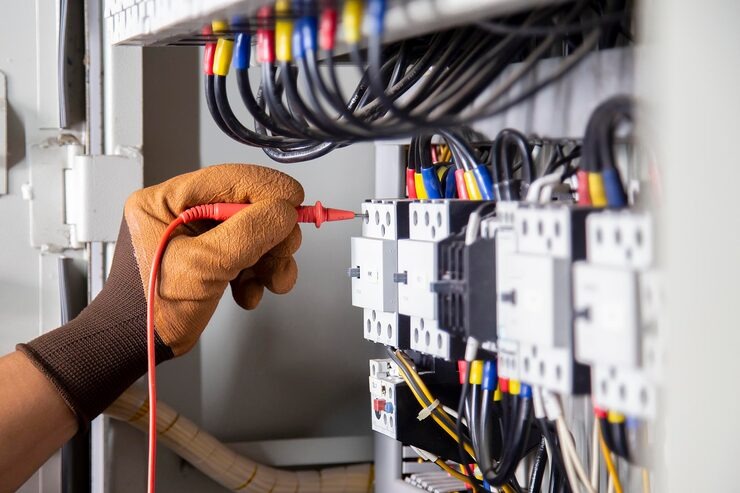
A panel replacement starts with the utility disconnecting power at the meter. That part’s on National Grid, not Brandon, and depending on scheduling it can be the piece that sets your date. Once the meter’s pulled, Brandon opens the old panel, disconnects every circuit, and confirms what he’s actually dealing with, because what’s behind the cover doesn’t always match what’s on the outside.
The old panel comes out. The new one goes in on the same wall, or a better spot if the original location was a problem, like a panel installed in a closet or too close to a water source, both of which fail inspection today even if they were legal decades ago. Every circuit gets reconnected to a properly sized breaker, wire gauge gets checked against the load it’s carrying, and any obviously dangerous wiring, like double-tapped breakers or aluminum branch circuits without the right connectors, gets flagged and addressed.
Power is out for the swap itself, usually a few hours, not the whole day. The utility restores service at the meter once the new panel passes rough inspection. Brandon handles everything from the meter socket inward. National Grid owns the drop and the meter itself.
What It Costs
A straightforward panel replacement in Peabody, same amperage, single-family, easy access, typically runs {PRICE_LOW} to {PRICE_HIGH}. What moves that number: how many circuits have to be re-terminated, whether the panel location has to change, whether there’s a second panel in a converted multi-family, and whether the mast or grounding needs work while the panel’s open anyway. A basement panel with clear access costs less to swap than one buried behind finished walls or crammed into a tight utility closet.
If your Federal Pacific or Zinsco panel is otherwise sized right for your house, this is a condition fix, not a capacity upgrade, and the price reflects that. If you’re also planning to add amperage for a heat pump or EV charger, that’s a different conversation and a different scope.
How Long It Takes
Most single-panel jobs in Peabody wrap up in one day, start to finish. The utility disconnect and reconnect at the meter can add scheduling time on either end depending on National Grid’s queue, which is worth planning around if you’re not in a rush. Multi-family properties with more than one panel to replace, or homes where the mast and grounding need attention at the same time, sometimes run into a second day.
Permits and Inspection
Panel replacement work requires a permit in Peabody and every North Shore town, and it gets inspected by the local electrical inspector before the utility will reconnect permanent power. Brandon pulls the permit as part of the job. This isn’t paperwork for its own sake, it’s the thing that separates a licensed replacement from the unlicensed panel swaps that show up on inspection reports during a home sale. [EXTERNAL LINK: Massachusetts electrical code and permitting requirements, mass.gov Board of State Examiners of Electricians]
Common Questions
How do I know if I have a Federal Pacific or Zinsco panel?
Look at the panel label inside the door. Federal Pacific panels usually say Federal Pacific Electric or FPE and have red Stab-Lok breakers. Zinsco panels often say Zinsco or GTE Sylvania. If you're not sure, send Brandon a photo of the panel with the cover off, or he can take a look on site before quoting anything.
Can I just replace one breaker instead of the whole panel?
On a Federal Pacific or Zinsco panel, no. The breakers on these panels were built to fail to trip properly under fault conditions, which is the actual defect, not just wear. Swapping one breaker doesn't fix that. The panel itself has to come out.
Will my homeowners insurance make me replace an old panel?
Some carriers will decline to insure a home with a known Federal Pacific or Zinsco panel, or will require replacement before renewing a policy. It's worth asking your agent directly, since this comes up a lot with Peabody's older housing stock during refinancing or a sale.
Do I need to upsize my amperage when I replace the panel?
How long does a panel replacement actually take?
Reach Out for Electrical Panel Replacement
If you’ve got an old panel, a Federal Pacific label, or you’re just not sure what’s behind that cover, call {PHONE}. Brandon can look at photos first or come take a look at the panel directly, and either way you’ll get a straight answer about what it actually needs.
Contact information
Talk to Brandon
Brandon left union work to run the electrical side of the family business, and panel work like this is a big part of what he does across Peabody and the rest of the North Shore. He’ll tell you straight whether your panel needs to come out now or whether it’s got some life left, and he won’t dress up a Federal Pacific panel as anything other than what it is.