
Dedicated Circuit Installation in Wenham, MA
A lot of Wenham houses were framed before central air was common and wired for a service that assumed a refrigerator, a washer, and maybe a window unit. Now the same panel is being asked to run a hot tub, a home office full of equipment, a standby generator transfer switch, and a car charger in the garage, and it was never built for that math.
Why Wenham Homes Need This
Wenham is low density with big lots and long driveways, and that changes what a circuit has to do. Homes here are more likely to be on well and septic, which means a well pump on its own circuit is not optional, it is the difference between water and no water when something trips. Outages also run longer at the end of a rural feed, which is why generator interlock and transfer switch work is some of the most requested circuit work we do in this town. Estate-sized lots often mean detached garages, barns, or pool houses that need their own sub-panel and feeder run rather than an extension cord solution.
Age is the other factor. A good share of the housing stock predates 1960, and that means we still find knob and tube wiring in walls that were never touched during a renovation, cloth-insulated conductors that have gone brittle, and 60 amp services that were adequate in 1955 and are not adequate now. We’ve also pulled Federal Pacific Stab-Lok panels out of Wenham basements, and those get flagged every time regardless of what else is on the job, because the breakers have a documented history of failing to trip under fault conditions.
What the Work Involves
A dedicated circuit means one breaker, one wire run, one outlet or hardwired connection, for one piece of equipment. No sharing, no daisy chaining. For a window AC or a kitchen appliance that might be a 20 amp, 12 gauge run. For an electric range or dryer it’s typically a 240 volt, 30 to 50 amp circuit on 10 or 8 gauge wire. An EV charger usually calls for a 40 to 60 amp circuit depending on the charger, and a generator interlock needs coordination between the main panel and the transfer equipment so the utility feed and the generator can never be connected at the same time.
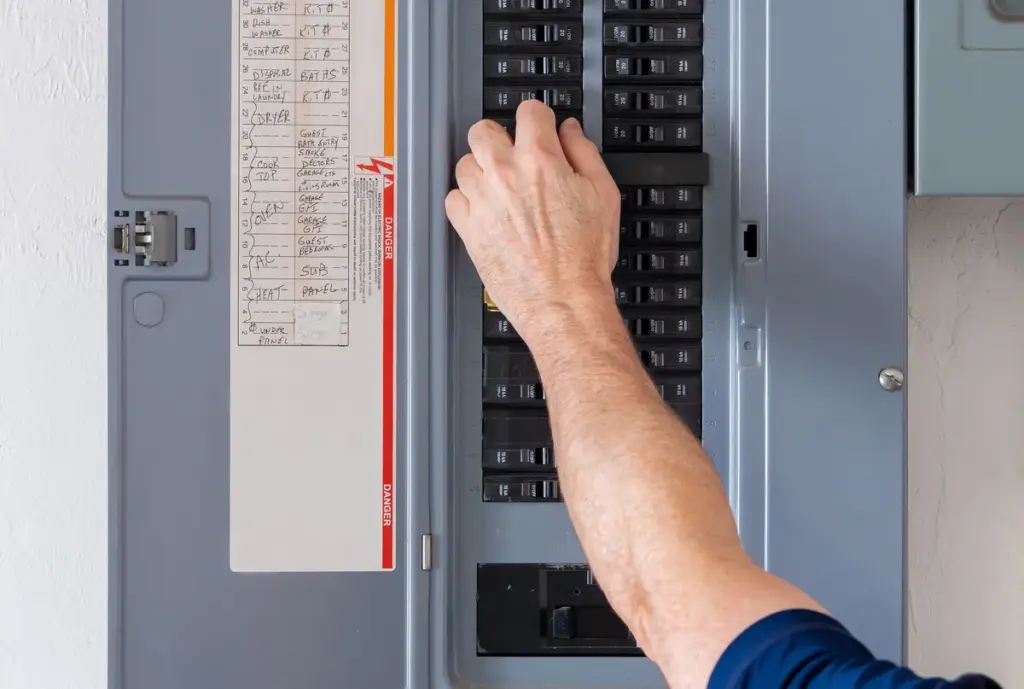
Brandon shuts down power to the panel section being worked on, not the whole house in most cases, and runs the new wire through conduit, finished wall, or basement joist bays depending on the house. If the panel itself is full, undersized, or unsafe, like an FPE box, that gets addressed as part of the same conversation rather than bolting a new breaker into a panel that shouldn’t have one added. Anything involving a new service size or a meter change requires coordination with the utility, since they own the drop and the meter and we own everything from there into the house.
What It Costs
A single dedicated circuit for something straightforward, a bedroom AC unit or a sump pump, generally runs {PRICE_LOW} to {PRICE_HIGH}. That range moves with wire run length, whether we’re fishing through finished walls or running open conduit in a basement, and whether the panel has room or needs a sub-panel added first. A 50 amp range or dryer circuit, an EV charger circuit, or a well pump circuit sits toward the upper end, especially in an older Wenham house where the panel is already at capacity and part of the job is making room before we can add anything. We’ll tell you which side of the range you’re on before any wire gets pulled.
How Long It Takes
A single new circuit in an accessible basement or garage is usually a half day. Add finished wall or ceiling access, a longer run out to a detached structure, or a sub-panel install, and it becomes a full day or two. The power to the affected circuit is out for the duration of the work, but we don’t kill the whole house unless the panel itself is being replaced. If the job needs a utility coordination step, like a service upgrade to support a new high-draw circuit, that adds scheduling time on the utility’s end that’s outside our control.
Permits and Inspection
Circuit work is permitted in Massachusetts, and it gets inspected by the local electrical inspector before it’s considered done. That’s true whether it’s one new outlet or a full panel swap. Brandon pulls the permit, schedules the inspection, and stands behind the work when the inspector walks through. If someone offers to do this off the books to save the permit fee, that’s the point where you should ask why. [EXTERNAL LINK: Massachusetts Board of State Examiners of Electricians licensing and code info, for homeowners who want to verify licensing requirements]
Common Questions
Do I need a permit for one new circuit?
Yes. Massachusetts requires a permit and inspection for electrical circuit work regardless of whether it's a single outlet or a full rewire. Brandon handles the permit and the inspection scheduling as part of the job.
My panel is a Federal Pacific Stab-Lok. Can you still add a circuit?
We'll look at it, but the honest answer is usually no, not without addressing the panel first. FPE panels have a known history of breakers failing to trip, and adding load to one isn't something we'll do without flagging it.
Can you run a circuit out to my detached garage or barn?
Yes, this is common in Wenham given the lot sizes. It usually means a trenched or overhead feeder to a sub-panel at the outbuilding, then circuits run from there.
Does a generator need its own circuit?
How do I know if my well pump needs a dedicated circuit?
Reach Out for Dedicated Circuit Installation
If you’re adding a hot tub, a generator, an EV charger, or finally splitting up an overloaded kitchen circuit, call {PHONE}. We work across Wenham and the rest of the North Shore, and we’ll look at the whole panel before we quote just the one circuit, because in a lot of these older houses that’s where the real answer is.
Contact information
Talk to Brandon
Brandon left union work to run electrical for the family business, and he’s the one who’ll walk your panel, tell you what it can handle and what it can’t, and give you a straight answer on whether you need one circuit or a bigger conversation about the panel itself. No pressure to upsell a service upgrade you don’t need, and no pretending a 60 amp box is fine when it isn’t.