
Dedicated Circuit Installation in Salem, MA
A lot of Salem’s housing stock went up before 1940, back when a house ran on a handful of lights and maybe a radio. Nobody wired those places for a microwave, a window AC, a table saw in the basement, or an EV charger in the driveway, and it shows every time a breaker trips for no obvious reason.
Dedicated circuit installation is how you give one demanding appliance or piece of equipment its own wire, its own breaker, and enough capacity to run without fighting the rest of the house for power.
Dedicated Circuit Installation in Salem
A dedicated circuit is a single circuit that feeds one outlet or one piece of equipment, nothing else sharing the line. Code requires it for things like electric ranges, dryers, dishwashers, microwaves, sump pumps, window AC units above a certain draw, and EV chargers. It is not optional wiring, it is the standard the National Electrical Code sets for anything that pulls a steady, heavy load.
In a newer subdivision this is a simple add. In Salem’s older housing, it usually means dealing with a panel that is already close to full, wiring that was never meant to carry today’s loads, and in some cases a service entrance too small to add much of anything.
Why Salem Homes Need This
Salem has a deep stock of pre-1940 single and multi-family houses, plus a large number of two and three family conversions where a single old service now feeds three kitchens instead of one. That combination puts real pressure on the electrical system every time someone plugs in a modern appliance.
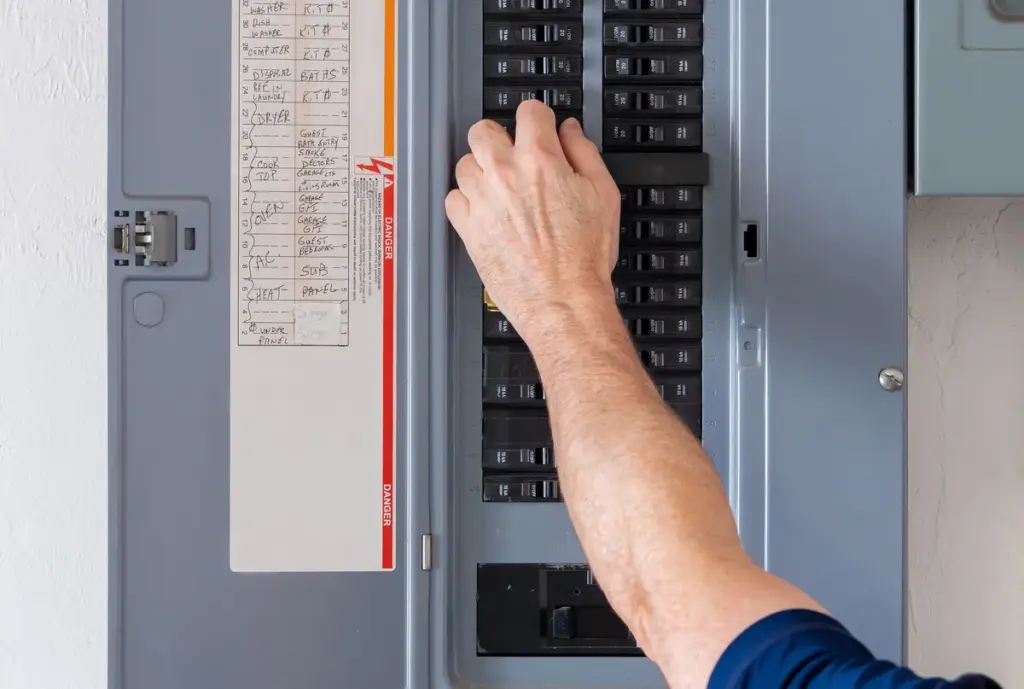
We still find knob and tube wiring in attics and wall cavities on a regular basis, along with cloth-insulated conductors that have gone brittle with age. Panels are often sized at 60 or 100 amps, which was fine for a 1930s household and is tight for a house running central air, a dishwasher, an electric dryer, and now maybe an EV charger too. Some of the panels themselves are Federal Pacific Stab-Lok or Zinsco units, both known for breakers that do not trip reliably under fault conditions, which is a separate problem from capacity but often shows up in the same inspection.
Salem’s historic district also puts real constraints on exterior and service-entrance work. Anything visible from the street, including new service masts, meter locations, or conduit runs on a historic facade, can run into design review before it gets touched. Brandon plans around that up front instead of finding out mid-job.
What the Work Involves
Every dedicated circuit job starts with a load calculation. Brandon checks what the panel is already carrying, what capacity is left, and whether the new circuit needs a specific breaker type; a 240-volt range circuit is a different animal than a 120-volt circuit for a microwave, and an EV charger circuit has its own sizing rules based on the charger’s amperage.
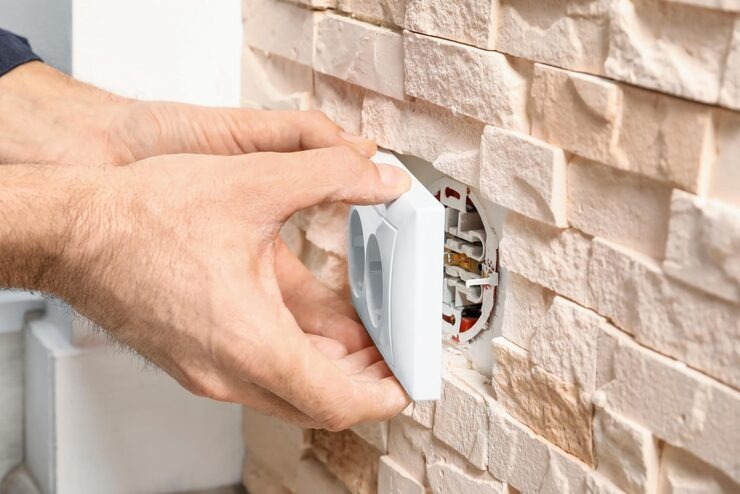
From there it is running wire of the correct gauge for the load, from the panel to the new outlet or hardwired connection, protecting it where it passes through framing, and landing it on a breaker sized to match the wire and the load, not oversized to stop nuisance tripping. Steady loads like an EV charger often need a breaker rated for continuous duty, sized differently than a breaker for something that cycles on and off.
Power to the affected circuit gets shut off for the work, usually just that circuit, not the whole house, unless the panel itself needs attention at the same time. Most single dedicated circuit jobs do not require the utility to touch anything, since the work happens downstream of the meter. If the panel is already maxed out, that changes the job, and Brandon will say so before starting rather than after opening the panel.
What It Costs
A straightforward dedicated circuit for something like a microwave or a sump pump, where the panel has room and the run is short, typically lands around {PRICE_LOW}. A 240-volt circuit for a range, dryer, or EV charger, especially with a longer run or work in finished walls, moves toward {PRICE_HIGH}.
What actually moves the number: distance from the panel to the new location, whether Brandon is fishing wire through finished walls and ceilings versus an open basement or attic, whether the panel has open breaker slots or needs a subpanel or breaker swap to make room, and whether the circuit needs a permit inspection scheduled separately. None of this gets guessed at. Brandon looks at the panel and the run in person and gives you a number before any wire gets cut.
How Long It Takes
A single dedicated circuit with an accessible run, open panel space, and no drywall to patch is usually a same-day job, often a few hours. Power to that one circuit is out for the duration of the work, but the rest of the house stays live.
Add a longer run through finished space, a panel that needs a breaker swapped to make room, or coordination with the historic district for exterior work, and the timeline stretches. Brandon will tell you which category your job falls into after he sees the panel and the path the wire needs to take, not before.
Common Questions
Do I really need a dedicated circuit, or can I just plug into an existing outlet?
For anything code classifies as a continuous or heavy load, an electric range, a dryer, a dishwasher, an EV charger, sharing a circuit isn't allowed and isn't safe. Sharing overloads the wire and the breaker wasn't sized for the combined draw. If you're not sure whether your appliance needs its own circuit, tell Brandon the model and amperage and he'll tell you straight.
My panel doesn't have any open breaker slots. Now what?
That's common in Salem's older 60 and 100 amp services. Options include a tandem breaker where code allows it, a subpanel to add capacity, or in some cases a full panel upgrade. Brandon will look at what's already on the panel and tell you the least invasive option that still meets code.
Can I get a dedicated circuit installed if my house still has knob and tube wiring?
Yes. The new circuit is run independently of the old wiring, so knob and tube elsewhere in the house doesn't block adding a properly sized modern circuit. It's worth flagging the old wiring anyway, since insurers sometimes ask about it separately from any electrical work you're doing.
Will the whole house lose power during the work?
Do I need a permit for one dedicated circuit, or just for panel upgrades?
Permits and Inspection
Dedicated circuit work is permitted in Massachusetts, and it gets inspected. That is not a formality, it is what separates a licensed electrician’s work from something a handyman wired on the side. Brandon pulls the permit, the local inspector reviews the completed work against the [EXTERNAL LINK: Massachusetts amendments to the National Electrical Code, to show the specific standard the circuit is built to], and the job gets signed off before it’s considered done.
For homes in Salem’s historic district, exterior electrical work, including new service equipment or conduit visible from the street, may also need to clear design review before the permit is issued. That step happens in parallel with the standard building permit, not instead of it.
Contact information
Reach Out for Dedicated Circuit Installation
Call {PHONE} and describe what you’re adding, whether it’s a new range, an EV charger, a dehumidifier, or shop equipment. Brandon will tell you what he needs to see in person and can usually get out to look at the panel within a few days. We work across Salem and the rest of the North Shore, and every circuit we install gets permitted and inspected, no shortcuts.
Talk to Brandon
Brandon is the licensed electrician side of Belfiore. He grew up working on this same North Shore housing stock and knows what a 1920s panel in a Salem two-family actually looks like inside, not just on paper. If you’re adding a range, a charger, or new equipment and you’re not sure the existing wiring can take it, that’s exactly the conversation to have before you buy the appliance.