
Dedicated Circuit Installation in Rowley, MA
A lot of Rowley houses were wired when a 100 amp service felt generous and the biggest single load in the house was a window air conditioner. Now you are trying to add a hot tub, a heat pump, a well pump upgrade, or a shop heater in the barn, and the panel that was fine for 1975 is not fine for what you are asking it to do today.
Why Rowley Homes Need This
Rowley is still a town of large lots, private wells, and septic systems, which means the electrical load profile here is different from a subdivision on town water. Well pumps need their own circuit, sized correctly for the pump’s horsepower and run length. Septic systems with alarm floats or aerobic treatment units need dedicated, clearly labeled circuits too, because nobody wants a nuisance trip to silently take out their pump alarm.
Add to that the age of the housing stock. Rowley has its share of farmhouses and older colonials where the original service is 60 or 100 amps, the branch wiring is cloth-insulated copper from a 1950s or 60s upgrade, and the panel itself is sometimes a Federal Pacific Stab-Lok or an early Zinsco – both known for breakers that don’t trip reliably under fault conditions. Before we run a new dedicated circuit off a panel like that, we tell you honestly whether the panel itself needs to be dealt with first.
And because Rowley loses power for real stretches when storms come through off the water and through the woods along Route 1A, a lot of these same houses run a generator. A dedicated circuit for a generator interlock or transfer switch is one of the most common reasons we get called out here, right alongside well pumps and EV chargers.
What the Work Involves
A dedicated circuit means one breaker, one wire run, one outlet or hardwired connection, feeding a single piece of equipment – nothing shared. For a kitchen appliance or window AC that might be a 20 amp, 12 gauge circuit. For an EV charger it’s usually a 40 or 50 amp, 240 volt circuit on 8 or 6 gauge copper. For a well pump it depends on the motor’s horsepower and starting current, which we calculate before we pull any wire.
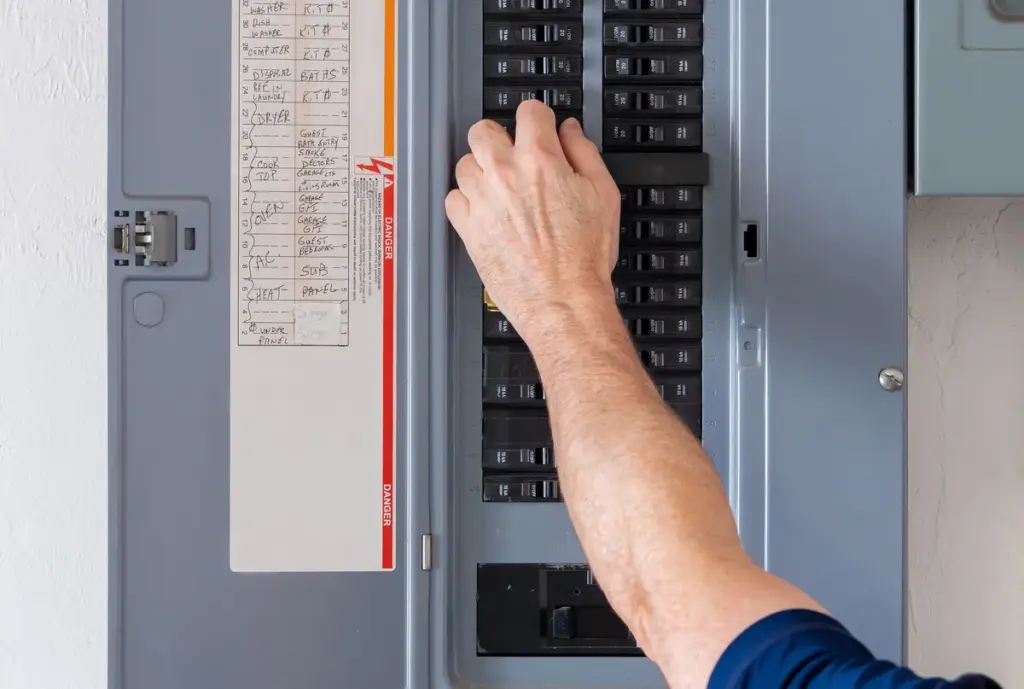
Brandon shuts down power at the panel for the time it takes to land the new breaker and make connections, usually well under an hour for the panel work itself. The rest of the job is running wire – through a basement or crawlspace, up a wall, sometimes through old plaster and lath, which takes more care and more time than it would in a house built after 1980. If the run needs to cross an exterior wall or go underground to a barn or detached garage, that’s additional conduit and trenching, and we’ll walk that with you before we start.
The utility doesn’t get involved unless the new load pushes your total service past what the existing meter and service entrance can handle – at that point it becomes a service upgrade conversation, not just a dedicated circuit.
What It Costs
Most single dedicated circuits in Rowley run {PRICE_LOW} to {PRICE_HIGH}. What moves the number: wire run length, whether we’re fishing through finished walls or running exposed conduit in a basement, the amperage and gauge required, and whether the existing panel has an open slot or needs a subpanel or tandem breaker to make room. Well pump and generator interlock circuits tend to sit toward the higher end because of the wire gauge and the extra labor of routing to a pump house or outdoor transfer switch. We give you the number before anything gets cut into.
How Long It Takes
A straightforward dedicated circuit, panel to a nearby room, is usually a half day. Longer runs – out to a detached garage, down to a well house, or through a First Period post-and-beam frame where every stud bay is a puzzle – can take a full day or two. We tell you which kind of job you have during the estimate, not after we’ve opened up a wall.
Permits and Inspection
Dedicated circuit work is permitted under Massachusetts electrical code, and it gets inspected by the local electrical inspector before it’s energized for good. That inspection is not paperwork for its own sake – it confirms the wire gauge matches the breaker, the grounding is correct, and the connections are made the way code requires. Brandon pulls the permit and coordinates the inspection as part of the job. [EXTERNAL LINK: Massachusetts Electrical Code (527 CMR 12) reference, to show the standard the work is held to]
Common Questions
Do I need a permit for a single dedicated circuit?
Yes. Any new circuit installed by a licensed electrician in Massachusetts gets a permit and a final inspection, even if it's just one outlet for one appliance.
My panel is a Federal Pacific Stab-Lok. Can you still add a circuit?
We can, but we'll tell you the risks first. Those panels are known for breakers that don't trip reliably under a fault, and a lot of Rowley homeowners choose to replace the panel at the same time rather than add more load to one they don't fully trust.
What size circuit does a well pump need?
It depends on the pump's horsepower and starting current. A typical 3/4 to 1 HP submersible pump often runs on a 20 or 30 amp 240 volt dedicated circuit, but we size it from the pump's nameplate, not a guess.
Can one circuit run both my generator interlock and my well pump?
Will I lose power to the whole house while you work?
Reach Out for Dedicated Circuit Installation
If you’re adding a hot tub, an EV charger, a generator interlock, or a well pump upgrade in Rowley, call {PHONE}. Tell Brandon what you’re installing and he’ll tell you what the circuit needs to look like and what it will cost to do it right.
Contact information
Talk to Brandon
Brandon is the electrician side of Belfiore. He’s licensed, he left union work to run the electrical side of his family’s business, and he’s the one who will look at your panel, your load, and your house’s wiring history before he tells you what a dedicated circuit for your project actually requires.