
Dedicated Circuit Installation in Reading, MA
Reading’s housing stock is mostly post-war colonials and split-levels with a wave of newer construction filling in the larger lots off Haverhill Street and South Main. Most of those older homes were wired for a stove, a dryer, and not much else. Now homeowners are adding EV chargers, heat pump condensers, and finished basements with home gyms and workshops, and the panel that came with the house was never built for that load.
Why Reading Homes Need This
A house built in the 1950s or 60s in Reading typically shipped with a 60 or 100 amp service and a handful of shared circuits. That was fine when the big draw in the house was a window AC unit. It is not fine when you are trying to run a Level 2 EV charger, a heat pump air handler, and a induction range off the same panel that has been carrying the load since Eisenhower.
We still find cloth-insulated wiring and knob-and-tube in the older sections of town, and it is not unusual to open a panel and find a Federal Pacific Stab-Lok or an old Zinsco breaker box behind it. Neither of those brands is made anymore, and both have a documented history of breakers that fail to trip when they should. Adding a new dedicated circuit off one of these panels is not something we do without first talking about whether the panel itself needs attention.
Reading is also EV country. Bigger lots mean garages and driveways that can actually fit a charger, and a lot of these houses are adding heat pumps for supplemental heating and cooling at the same time. Both of those loads want their own circuit, sized correctly, not spliced into whatever outlet happened to be closest.
What the Work Involves
A dedicated circuit means one breaker, one wire run, one outlet or hardwired connection, feeding a single piece of equipment. No sharing with the kitchen lights or the bedroom outlets. For a 240-volt appliance like an EV charger, a range, or a heat pump, that usually means a double-pole breaker and wire sized to the amperage the manufacturer specifies, run in cable or conduit from the panel to the equipment location.
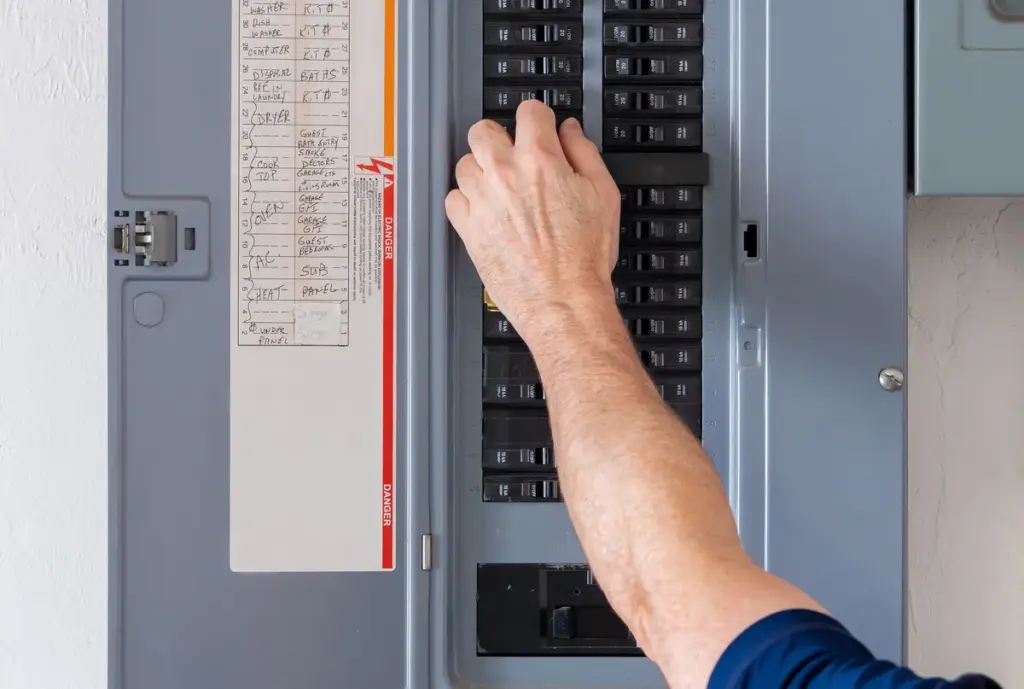
Brandon starts by checking what the panel can actually support. If there is open capacity and the right amperage available, the job is a wire pull and a new breaker. If the panel is full or the service itself is undersized, that conversation happens before any wire gets run, not after.
Power to the house gets shut off for the time it takes to land the new breaker safely, usually well under an hour. That is different from a utility-side service upgrade, where National Grid or the town’s electric provider has to disconnect and reconnect at the meter, which is their work, not ours, and depends on their scheduling. A standard dedicated circuit for an appliance or an EV charger does not usually require utility involvement at all unless it is tied into a larger service upgrade.
What It Costs
A straightforward dedicated circuit in Reading, from panel with available capacity to a garage EV charger or a kitchen appliance, generally runs {PRICE_LOW} to {PRICE_HIGH}. What moves that number is distance from the panel, whether the wire run is through finished walls or an open basement ceiling, whether the panel has room for a new breaker, and whether the circuit is 120-volt or 240-volt.
Finished basements add cost because the wire has to be fished through drywall instead of run exposed along joists. A garage on the far side of the house from the panel costs more than a garage that shares a wall with it. None of this gets quoted over the phone with any confidence. Brandon looks at the panel and the run in person before giving you a number.
How Long It Takes
Most single dedicated circuits are a one-day job, sometimes a half day if the panel is accessible and the run is short. Longer runs through finished space, or jobs where we’re adding a subpanel to support multiple new circuits at once, can stretch to two days. The power interruption itself is short. The bulk of the time is the wire pull and the finish work of patching or securing the new run.
Permits and Inspection
Dedicated circuit work is electrical work under the Massachusetts electrical code, and it gets a permit and a town inspection like any other licensed job. Reading requires a permit for new circuits, and an inspector reviews the work before it gets closed up behind drywall or finished walls. That inspection is your protection. It confirms the wire gauge matches the breaker size, the grounding is correct, and the installation meets code, not just that it works when you flip the switch. [EXTERNAL LINK: Massachusetts Board of State Examiners of Electricians licensing and code reference – useful for homeowners verifying an electrician’s license or checking permit requirements.]
An unlicensed installer or a well-meaning DIY job can pass a visual check and still be a fire risk. Skipping the permit doesn’t just skip paperwork, it skips the inspection that catches the mistakes you can’t see once the wall is closed.
Common Questions
Do I need a dedicated circuit for an EV charger?
Yes. Level 2 EV chargers draw enough continuous current that they need their own circuit and breaker sized specifically for the charger, not a shared garage outlet.
Can my existing panel handle a new dedicated circuit?
It depends on the panel's amperage and how much is already in use. Older Reading homes with 60 or 100 amp services, or Federal Pacific and Zinsco panels, often need a panel upgrade before a new heavy-load circuit is safe to add.
Is a permit really required for one circuit?
Yes. Massachusetts requires a permit and inspection for new electrical circuits, regardless of how small the job looks. That inspection is what confirms the wiring is actually safe behind the wall.
How disruptive is the installation?
What appliances typically need their own circuit?
Reach Out for Dedicated Circuit Installation
If you’re adding an EV charger, a heat pump, a new range, or wiring a finished basement in Reading, call {PHONE} and describe what you’re installing. Brandon can usually tell you over the phone whether it sounds like a straightforward circuit or a panel conversation, and get a time on the calendar to look at it in person.
Contact information
Talk to Brandon
Brandon is the licensed electrician at Belfiore. He left union work to run the electrical side of the family business, and dedicated circuits for EV chargers, heat pumps, and appliance loads are a big part of what he does in Reading. He’ll tell you plainly whether your panel has room for what you’re adding, and if it doesn’t, what the actual options are before anything gets torn open.