
Dedicated Circuit Installation in Boxford, MA
A lot of Boxford’s housing stock is farmhouse-era or built during the estate-lot boom of the 1970s and 80s, and either way the service panel was sized for a house that didn’t have a hot tub, a home office full of monitors, a 240-volt EV charger in the garage, and a generator transfer switch all pulling from the same box. Every time someone adds a kitchen island with an induction range or wires up a workshop on a five-acre lot, that original panel gets asked to do more than it was built for.
A dedicated circuit is the fix: one breaker, one wire run, one job, so that appliance or piece of equipment isn’t sharing capacity with anything else in the house.
Why Boxford Homes Need This
Boxford is low density with long driveways, well pumps, septic systems, and a lot of distance between you and the nearest utility pole. When a storm takes down a line out here, it can take longer to come back than it would closer to Salem, which is exactly why generator demand is higher in this town than almost anywhere else we work. A whole-house or large portable generator needs its own dedicated feeder to the transfer switch, sized correctly so it doesn’t overload under load.
The other side of it is age. Some of Boxford’s older farmhouses still have knob-and-tube wiring in the walls or a 60 amp service that predates central air, let alone an EV charger. We still run into the occasional Federal Pacific Stab-Lok panel out this way too, and those are a known fire risk that most insurance carriers won’t sign off on anymore. Before we can add a clean 50 amp circuit for a car charger or a 30 amp line for a well pump, we sometimes have to deal with what’s already in that panel first.
What the Work Involves
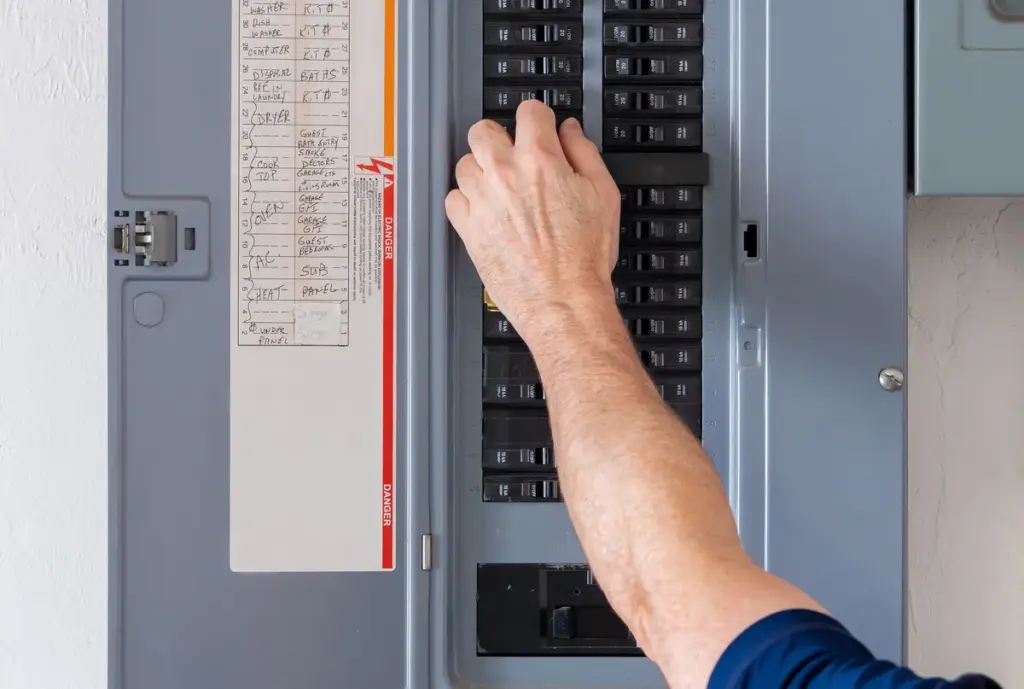
Every dedicated circuit starts at the panel. Brandon checks available capacity – open slots, total amperage, and whether the panel itself is original equipment or something that’s already been swapped once. From there it’s a wire pull from panel to destination: through a basement, up through a wall cavity, or out to a detached garage or barn, which is common on Boxford’s larger lots.
- Wire gauge is matched to the load – 12 AWG for a 20 amp circuit, 10 AWG for 30 amp, 6 AWG for a 50 amp EV charger or range circuit.
- The breaker type matters too – a straight single-pole breaker for most loads, GFCI or AFCI protection where code requires it, and a two-pole breaker for anything running 240 volts.
- The main breaker gets shut off only for the few minutes it takes to land the new circuit inside the panel. The rest of the run – fishing wire, drilling plates, mounting the outlet or junction box – happens with the rest of your house still powered.
If the job involves the utility’s side of the meter, like a full service upgrade to feed a new subpanel, National Grid or your utility has to schedule the disconnect and reconnect at the pole. That’s outside our control on timing, but Brandon coordinates it so it doesn’t stall the rest of the work.
What It Costs
A single dedicated circuit for something straightforward – a well pump, a dishwasher, a window AC – generally runs {PRICE_LOW} to {PRICE_HIGH}. What moves that number is wire run length, whether we’re pulling through open framing or finished walls, and whether the panel has room or needs a subpanel added first.
EV charger circuits and generator transfer switch feeds sit at the higher end of that range because of the wire gauge and breaker size involved, and because a lot of Boxford properties need a longer run to a detached garage or barn. If the panel itself needs work before we can even add the circuit – which is common with 60 amp services and older Federal Pacific equipment – that’s priced separately and Brandon will tell you upfront if it’s likely.
How Long It Takes
A single circuit in an accessible basement or crawlspace is usually a half-day job, start to finish, including the permit paperwork. Longer runs out to a barn, workshop, or detached garage – not unusual on Boxford’s bigger lots – can take a full day once you factor in trenching or running conduit outside.
If the job uncovers a panel that needs replacing before the new circuit can go in safely, that adds a separate day and its own inspection. Brandon will flag that possibility during the initial look at your panel, not after the walls are already opened up.
Permits and Inspection
Every dedicated circuit we install in Massachusetts gets a permit, full stop. That’s not optional and it’s not a formality – the local inspector has to see the work before the panel cover goes back on permanently. It’s the difference between a licensed electrician and someone working out of a truck with no license, and it’s also what protects you if you ever sell the house or file an insurance claim tied to electrical work.
The National Electrical Code sets the baseline for wire sizing, breaker protection, and clearance requirements, and Massachusetts amends that code at the state level. [EXTERNAL LINK: Massachusetts Board of State Examiners of Electricians – licensing and code reference, useful for homeowners who want to verify a contractor’s license] is a good place to check that any electrician pulling a permit in your name is actually licensed to do it.
Common Questions
Do I need a permit for a dedicated circuit in Boxford?
Yes. Massachusetts requires an electrical permit for any new circuit, and the town inspector has to sign off before the panel cover goes back on for good. Brandon pulls the permit as part of the job, so you are not the one calling the inspector's office.
Can my existing panel handle another circuit?
Depends on the panel. A lot of Boxford's older farmhouses are still on 100 amp or even 60 amp services with full breaker slots, which means a new dedicated circuit may require a subpanel or a full service upgrade before we can even run the wire.
How many dedicated circuits does a whole-house generator need?
None directly, but the automatic transfer switch that ties the generator to your panel is wired on its own dedicated feeder, sized to the generator's output. It is a similar permit and inspection process to any other dedicated circuit.
What gauge wire does a 50 amp EV charger circuit need?
Will the power be off during the work?
Reach Out for Dedicated Circuit Installation
If you’re adding a generator, an EV charger, or equipment that needs its own circuit, call {PHONE}. We work across Boxford and the rest of the North Shore, and we’ll walk you through what your panel can handle before we start any work.
Contact information
Talk to Brandon
Brandon left union electrical work to run the electrical side of this family business, and dedicated circuits are some of the most common calls he gets from Boxford – generators, EV chargers, and the occasional barn or workshop that needs power for the first time. He’ll look at your panel, tell you honestly whether it can take another circuit or needs work first, and give you a number before anything gets opened up.