
Ceiling Fan and Light Fixture Installation in Reading, MA
A lot of Reading’s housing stock went up in the postwar boom and the decades right after, on the kind of larger lots that let people add rooms, finish basements, and now park an EV in the driveway. Those houses came with electrical service sized for a much smaller life than the one running through them today. Swapping a boob light for a ceiling fan sounds simple, and it usually is, but it is also the first honest look most homeowners get at what their wiring can actually handle.
Ceiling Fan and Light Fixture Installation in Reading
We install ceiling fans and light fixtures in Reading homes ranging from 1950s capes to newer colonials near the Ipswich River side of town. Some jobs are a straight swap where the existing box and wiring are fine and the fan just needs a properly rated fan brace. Others turn into a bigger conversation once we’re up in the ceiling and find aluminum branch wiring, no ground, or a box that was never meant to carry the weight of anything heavier than a light kit. Either way, the job gets done to code, not just to “it spins.”
Why Reading Homes Need This
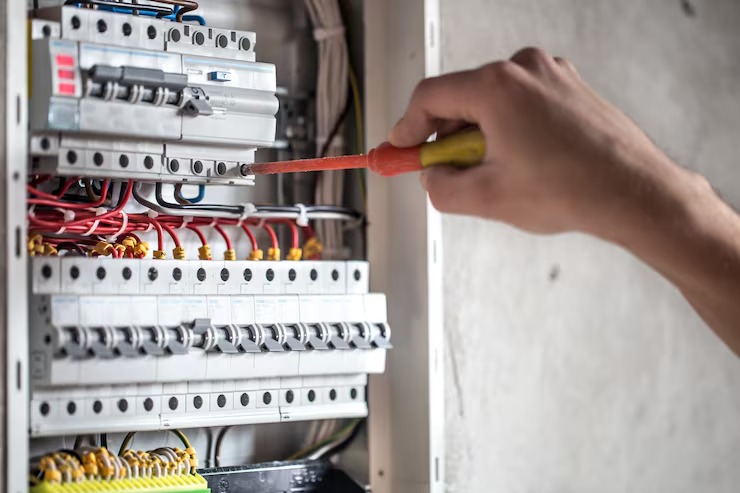
Reading’s neighborhoods split roughly into two eras: older sections closer to the center with homes built before or shortly after 1950, and the larger-lot subdivisions built through the 1960s, 70s, and beyond further out. The older homes are the ones where we still find knob and tube remnants, cloth-insulated branch circuits, and original 60 amp services that were never touched during a renovation. Some still have Federal Pacific or Zinsco panels from later upgrades, both of which have documented breaker failure issues and are worth flagging any time we’re already in the panel for other work.
The newer stock isn’t off the hook either. A house built in 1975 with a 100 amp panel was sized for a furnace, a dryer, and maybe central air. It was not sized for a heat pump, a finished basement with a home theater, and a Level 2 EV charger in the garage. That’s the real reason ceiling fan calls turn into bigger conversations here – not because we’re trying to sell more work, but because the panel and the wiring are often the actual limiting factor, and a fan install is usually the first time anyone’s looked at it closely.
What the Work Involves
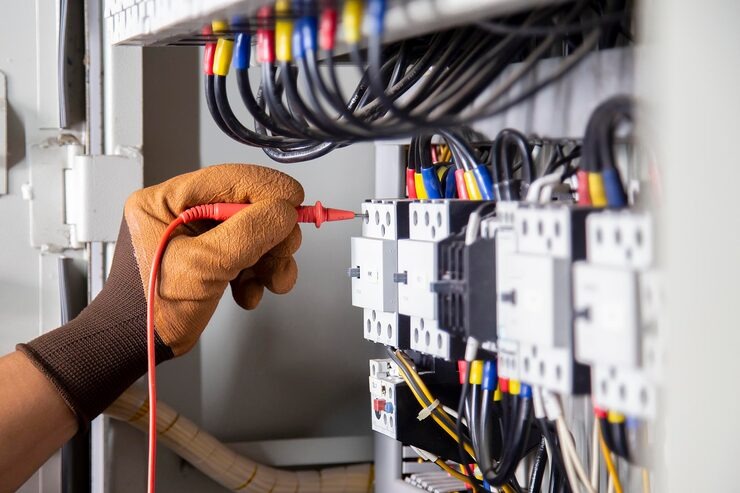
For a straightforward fan or fixture swap, we kill power to the circuit at the panel, confirm it’s dead with a meter (not just the switch), and pull the old fixture. If the existing electrical box isn’t rated to support a ceiling fan’s weight and vibration, we replace it with a listed fan-rated box, secured either to a joist or with a brace bar spanning between joists. We check the wire gauge and condition while we’re up there, run the new fixture, and test it under load before we close up.
Power is out for that specific circuit for the duration of the job, usually under an hour for a single fixture. It does not affect the rest of the house. If we’re adding a new switch, a dimmer compatible with the fan’s motor, or a remote/wall control setup, that adds time but not much. There’s no utility involvement for a fixture swap – Reading Municipal Light Department only gets pulled in if the job requires new service capacity, which is a different job entirely and something we’d flag separately.
What It Costs
A single ceiling fan or fixture install with an existing, adequate box typically runs {PRICE_LOW} to {PRICE_HIGH}. What moves that number: whether the box needs replacing with a fan-rated one, whether there’s existing wiring to reuse or new wire needs to be run, ceiling height and access, whether you want a wall switch added or converted to a dimmer/remote setup, and how many fixtures you’re doing in one visit. Multiple fixtures on the same trip almost always costs less per fixture than separate calls. We give you the number before anything gets touched.
How Long It Takes
One fan or fixture with a good existing box: usually an hour to two hours. Add a fan-rated box replacement, a new switch leg, or working in a finished ceiling where we need to cut and patch access, and you’re looking at a half day. Multiple fixtures in one visit take longer overall but less time per fixture, since the panel is already shut down and the tools are already out.
Common Questions
Can I install a ceiling fan myself if I already have a light fixture there?
You can, but the box matters more than the wiring. Standard light fixture boxes are not rated for the weight and vibration of a ceiling fan and can fail over time, so if the existing box isn't fan-rated, it needs to be swapped before a fan goes up, regardless of who does the work.
Do I need a bigger electrical panel just to add a ceiling fan?
No. A single fan or fixture on an existing circuit almost never requires panel work. Panel capacity becomes relevant when you're adding several new circuits at once, like a fan plus a finished basement plus an EV charger down the road.
What's the difference between a dimmer switch and a fan speed control?
A standard dimmer is built for incandescent or LED loads, not motors, and using one on a fan can cause humming or damage the motor over time. Fans need a control rated for motor loads, or a remote/wall control kit matched to that specific fan.
How do I know if my Reading home has knob and tube or aluminum wiring?
Is a permit really required for something this small?
Permits and Inspection
Electrical work in Massachusetts requires a permit pulled by a licensed electrician, and ceiling fan or fixture installs that involve new wiring, a new box, or a new switch fall under that requirement. Reading’s inspector reviews the work before it’s considered closed out. This isn’t paperwork for its own sake – it’s the difference between an install that’s on record as done correctly and one that’s invisible until it causes a problem, usually right when you’re trying to sell the house. Anyone offering to skip the permit is telling you something about the rest of the work too.
Contact information
Reach Out for Ceiling Fan and Light Fixture Installation
If you’ve got a fan or fixture waiting to go up in a Reading home, or an old fixture that’s starting to feel like it’s held on by hope, call {PHONE}. We’ll ask a few questions about the room and the circuit, get you a real number, and get it scheduled.
Talk to Brandon
Brandon handles the electrical side of the business and is the one who'll be under your ceiling checking the box, the wire, and the circuit before anything gets hung. If it turns into a bigger conversation about your panel or your service size, he'll tell you plainly what he's seeing and what the actual options are, not a sales pitch built around a fan swap.