
Recessed Lighting Installation in Amesbury, MA
A lot of Amesbury’s older homes, the capes and colonials in the older sections of town, and the mill-era doubles closer to downtown, were built with plaster-and-lath ceilings and shallow joist bays, neither of which was designed with a recessed can light in mind. Cutting into a ceiling like that for the first time is different work than cutting into modern drywall, and it shows in how the job gets planned.
Recessed Lighting Installation in Amesbury
Why Amesbury homes need this
Plaster-and-lath ceilings are common in the town’s older housing stock, and they behave differently than drywall once you start cutting into them. Plaster is brittle around the edges of a cut, and a hole saw that would leave a clean edge in drywall can crack a plaster ceiling if it’s rushed. Homes from this era also tend to have shallower joist bays than newer construction, which limits how deep a fixture can sit and rules out some fixtures in favor of shallow-mount cans.
A number of homes in the area still have knob-and-tube wiring running through ceiling cavities, even where the visible fixtures and outlets have been updated. Massachusetts code restricts how close insulation can sit to knob-and-tube wiring, and a recessed light installed near an active knob-and-tube run needs to account for that clearance, not just the clearance the fixture itself requires. It’s one of the first things Brandon checks before cutting anything.
Recessed lighting also comes up a lot in kitchen remodels and finished basements, where an older flush-mount fixture or a single ceiling light no longer keeps up with what the room is being used for. In a lot of the older capes and ranches around town, ceiling height runs low, and a hanging or surface-mounted fixture can make a room feel more crowded than it needs to. Recessed cans keep the ceiling line clean, which matters more in a seven-foot ceiling than it does in a newer build with nine-foot ceilings.
What the work involves
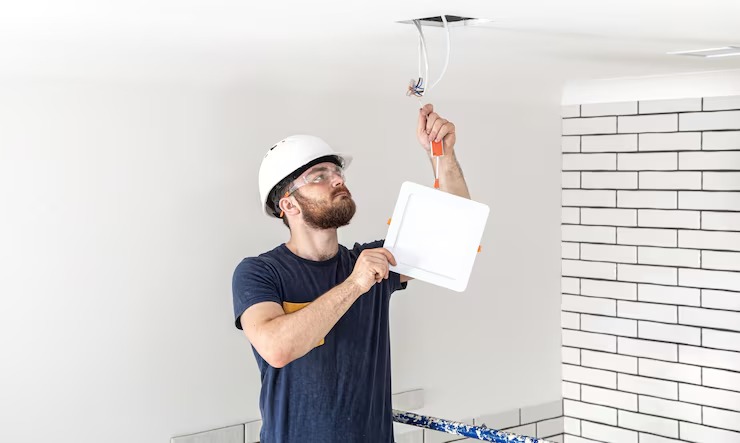
Layout comes before any cutting starts. Brandon maps out fixture spacing based on the room’s dimensions and ceiling height, generally a can every four to six feet depending on how much ambient light the room needs, and adjusts that spacing around joists, ductwork, and any knob-and-tube runs found during the walkthrough. Color temperature gets matched to whatever else is in the room, so a kitchen getting new recessed lighting next to existing under-cabinet lights doesn’t end up with two different shades of white.
Where there’s attic access above the room, new construction cans get installed from above, which is faster and gives more control over exact placement relative to joists and existing wiring. Where there’s no attic access, such as a room under a finished second floor or a cathedral ceiling, the work switches to remodel cans installed from below, cut directly through the existing ceiling.
Fixtures get chosen based on what’s above them. Insulation-contact (IC) rated fixtures are required anywhere insulation touches or comes close to the housing, which is most ceilings below an unconditioned attic. Air-tight housings are worth the small extra cost in most of these homes, since they cut down on air leakage into the attic space above.
Wiring gets fished can to can through the joist bays, landed on the switch location, and tested. If the room is going onto a dimmer, the dimmer matters as much as the fixture. Older toggle and rotary dimmers built for incandescent bulbs often flicker or buzz with LED recessed lights, so swapping in an LED-rated dimmer is usually part of the job rather than an optional add-on.
What It Costs
Recessed lighting installation in Amesbury can vary in cost depending on the number of fixtures being installed, the accessibility of the installation area, and the type of ceiling involved. A project with easy attic access may require less labor, while installations in areas without access above the ceiling or with more challenging materials such as plaster may require additional work. The layout of the space, wiring requirements, and any adjustments needed to complete the installation properly can also affect the overall cost. Belfiore Home Services can evaluate your home and explain the work involved before providing a project estimate.
How long it takes
Permits and inspection
Electrical work in Massachusetts requires a permit, and only a licensed electrician can pull one. The town inspects the finished work before it’s signed off. That applies to recessed lighting the same as any other electrical job, and it’s part of what separates a licensed installation from a weekend project with a big box store lighting kit.
Common Questions
Will cutting into my plaster ceiling cause cracking?
Do I need IC-rated fixtures?
Can I get recessed lighting in a room with no attic access above it?
Will my current dimmer work with LED recessed lights?
How many recessed lights does a room need?
Talk to Brandon
If you’re planning recessed lighting for a kitchen, living room, or finished basement in Amesbury, and you’re not sure whether your ceiling has attic access or what that means for the job, Brandon can walk through it with you before any cutting starts. Call Belfiore Home Services at 978-637-5418.
Contact information
Reach Out for Recessed Lighting Installation
Call us at 978-637-5418 or contact us for your free quote.